Given the time of year and given that one of my functions here in UCD is to provide the undergrad behavioural economics curriculum forgive me another random post on what we are actually supposed to do in the undergrad domain. Below is the result of scribbling on a piece of paper in an attempt to get motivated for this year's endeavours. This is close to another issue that we have started debating a lot more - what is the value of "inperson" modules as opposed to downloading modules from the web?
(i) Give students an opportunity to signal their ability to the labour/graduate admissions market. To provide challenging assignments that are known to be challenging.
(ii) Provide access to information that will be intrinsically valuable for the students both now and in the future on reflection. In essence to provide a consumption product at the same time as allowing the student to invest in a stock of knowledge and positive memories.
(iii) Provide access to language that will enable them to communicate with other people who have taken the course.
(iv) Provide a link between the university setting and the outside world through practical examples, case studies etc., In essence, to give students a chance to "practice" being a decision maker before having to make real decisions.
(v) Similar to (iv) to provide students with an opportunity to express innate talents through interaction with others in group situations similar to real-world settings.
(vi) Provide specific marketable skills valued by employers in different sectors.
(vii) Get to know students in the module well enough to be able to provide employment references.
(viii) Awaken consciousness about how real-world institutions operate and their own potential place in this.
(ix) To act as a guarantor that a student has come through a module of study that is a requirement for later education/jobs.
(x) Provide students with an opportunity to form networks through the class both personal and professional. Synching up modules across universities an interesting way to develop this.
(xi) Provide a forum for students to discuss and develop their own ideas. Provide feedback on those ideas including references to wider literaturem, challenging gaps in reasoning and so on.
(xii) Provide students with an independent forum for advanced critical thinking. Provide an atmosphere of irreverance toward current norms facilitating development of original thinking.
Tuesday, August 31, 2010

Monday, August 30, 2010
Attanasio and Weber Review of Theories of Consumption and Savings
Consumption and Saving: Models of Intertemporal Allocation and Their Implications for Public Policy
Author info | Abstract | Publisher info | Download info | Related research | Statistics| Author Info |
Guglielmo Weber
Additional information is available for the following registered author(s):
| Abstract |
This paper provides a critical survey of the large literature on the life cycle model of consumption, both from an empirical and a theoretical point of view. It discusses several approaches that have been taken in the literature to bring the model to the data, their empirical successes and failures. Finally, the paper reviews a number of changes to the standard life cycle model that could help solve the remaining empirical puzzles.
Early Research Performance of PhD Graduates in Labour Economics (EU and US)
Richard Tol on IrishEconomy links to the paper below.
Comparing the Early Research Performance of PhD Graduates in Labor Economics in Europe and the USA
Author info | Abstract | Publisher info | Download info | Related research | Statistics| Author Info |
Paulo Guimarães
Klaus F. Zimmermann
Additional information is available for the following registered author(s):
| Abstract |
This paper analyzes the early research performance of PhD graduates in labor economics, addressing the following questions: Are there major productivity differences between graduates from American and European institutions? If so, how relevant is the quality of the training received (i.e. ranking of institution and supervisor) and the research environment in the subsequent job placement institution? The population under study consists of labor economics PhD graduates who received their degree in the years 2000 to 2005 in Europe or the USA. Research productivity is evaluated alternatively as the number of publications or the quality-adjusted number of publications of an individual. When restricting the analysis to the number of publications, results suggest a higher productivity by graduates from European universities than from USA universities, but this difference vanishes when accounting for the quality of the publication. The results also indicate that graduates placed at American institutions, in particular top ones, are likely to publish more quality-adjusted articles than their European counterparts. This may be because, when hired, they already have several good acceptances or because of more focused research efforts and clearer career incentives.
NBER Paper: Determinants of Joining Employee Share Plans
To Join or Not to Join? Factors Influencing Employee Share Plan Membership in a Multinational Corporation
Alex Bryson, Richard B. Freeman NBER Working Paper No. 16292 Issued in August 2010 Many firms encourage employees to own company stock through share plans that subsidize the price at favorable rates, but even so many employees do not buy shares. Using a new survey of employees in a multinational with a share ownership plan, we find considerable variation in joining among observationally equivalent workers and explore the reasons for the variation. Participation in the plan is higher the greater the potential pay-off from joining the share plan, which indicates that rational economic calculations affect the decision to join. But there is also evidence that psychological factors affect the decision to join. Some non-members say they intend to join in the future, which means they forgo the benefits of immediate membership. The proportion of workers who purchase shares varies across workplaces beyond what we predict from worker characteristics. This suggests that co-worker behavior influences decisions. Indeed, workers say that they pay most attention to other workers and little attention to company HR management in their decision on joining. |
Class Interaction and Problem Based Learning
Am currently debating both with myself and others as to the relative merits of different approaches to supplement lecture courses and traditional tutorials and problem sets, in particular to create classes where the students are very motivated to perform and go beyond the basic materials. One great thing about looking at the Harvard Justice class is the amount of interaction with the student audience. It drives a number of the lectures. One particularly thorny one is the approach in some institutions of making attendance mandatory and of allocating a proportion of grade to how well the student deals with questions thrown at them in class, and how fully they participate in class discussion.
A few useful links below to problem-based learning approaches, which is another approach to getting classes to move beyond passive listening and toward very active engagement with the topics.
Problem-based learning: an introduction:
http://www.ntlf.com/html/pi/9812/pbl_1.htm
PBL for economics:
http://www.economicsnetwork.ac.uk/handbook/pbl/
Setting up a partial PBL environment:
http://www.economicsnetwork.ac.uk/handbook/pbl/52
PBL at Maastricht University (university which uses PBL in all programmes):
http://www.maastrichtuniversity.nl/web/Main/Education/EducationalProfile/ProblemBasedLearning.htm
PBL in Ireland:
http://www.facilitate.ie/
PBL at UCD: http://www.ucd.ie/vavctest/johntest/sociology_0805/PBL/html/what_is_pbl.html
A few useful links below to problem-based learning approaches, which is another approach to getting classes to move beyond passive listening and toward very active engagement with the topics.
Problem-based learning: an introduction:
http://www.ntlf.com/html/pi/9812/pbl_1.htm
PBL for economics:
http://www.economicsnetwork.ac.uk/handbook/pbl/
Setting up a partial PBL environment:
http://www.economicsnetwork.ac.uk/handbook/pbl/52
PBL at Maastricht University (university which uses PBL in all programmes):
http://www.maastrichtuniversity.nl/web/Main/Education/EducationalProfile/ProblemBasedLearning.htm
PBL in Ireland:
http://www.facilitate.ie/
PBL at UCD: http://www.ucd.ie/vavctest/johntest/sociology_0805/PBL/html/what_is_pbl.html
Russ Roberts and Dan Pink debate "Drive"
Below is from the EconTalk podcast website, posted by Russ Roberts.
"The latest EconTalk is Dan Pink talking about motivation and incentives, the themes of his book, Drive. The book is based on research results from behavioral psychology that often find perverse results or non-results from using money or other rewards to motivate people. In the podcast, I challenge the reliability and applicability of these results. Pink pushes back. We also talk at length about education and family life. Enjoy."
Mac or PC - Should researchers care?
I have been using a Macbook for the last three years. My subjective experience (n=1) has been neutral. It has better battery time than any other laptop I have owned, which is great. But I have not really noticed a definable advantage other than that for someone like me, who mainly uses Office, Firefox, Mail and STATA as my daily tools. Having said that, I know at least one Institute Director who swears by it and many others who have converted and claim that it has helped them be more productive. From the point of view, say, of a researcher starting here in Geary or someone beginning their PhD in Economics and about to purchase a laptop, does it make much of a difference? People tell me that one can simply install Windows on the Mac to get something from both worlds but lets restrict to the choice between Mac computer and default mac operating system versus a standard PC and windows operating system. There are a lot of claims about the relative security of Mac over PC that I can't evaluate. I am interested in whether anyone thinks the choice is an important one for researchers.
Don't worry I am running out of technology issues that interest me so these posts will dry up soon!
Don't worry I am running out of technology issues that interest me so these posts will dry up soon!
Sunday, August 29, 2010
Work for Dole Scheme Announced
Details are sketchy at present. RTE report that roll-out of this programme is imminent. Unemployment claimants will be required to work 20 hours in community projects in return for unemployment payments should they be unable to find a job.
I will post further details later as we know more about it. The human capital destruction taking place in Ireland at present will be the main legacy of this period and so activation policies like this are extremely important. The emphasis must be on avoiding spirals into long-run unemployment and preventing spells of unemployment from effectively stigmatising people out of the labour market. At first glance, this could be a very good policy but more details needed.
"Unlike applicants for job seekers benefit they will not be means tested and they can work part-time outside of the scheme as well. But if claimants do not turn up for the hours they are expected to work under the scheme, their dole will be stopped. The changes are being implemented as part of the expansion and development of the Community Services Programme and the Rural Social Scheme. It is expected that the changes will involve up to 10,000 new participants this year, rising to 40,000 over the course of two years"
I will post further details later as we know more about it. The human capital destruction taking place in Ireland at present will be the main legacy of this period and so activation policies like this are extremely important. The emphasis must be on avoiding spirals into long-run unemployment and preventing spells of unemployment from effectively stigmatising people out of the labour market. At first glance, this could be a very good policy but more details needed.
Case Studies
Kevin raised the issue of case studies in psychology as a research tool. Another prominent use of the case study method is in business schools, particularly for MBA classes. These are essentially vignettes, often based on actual events, where students are presented with real-world business dilemmas and asked to come up with solutions in time-pressured environments working either individually or in teams. Some examples of the Harvard case studies are linked here. Case studies are less prominently used in teaching Economics (though examples welcome). There are a lot of potential advantages to integrating them in that they encourage a lot of debate and force people to think about how textbook material applies in less defined settings.
Economics, Psychology and Neuroscience One-Day Event
As mentioned before, our one day event will take place on November 23rd. The keynote speaker will be Professor David Laibson, and other speakers will include Peter Lunn (ESRI), Robert Metcalfe (Oxford) and John McHale (NUIG). The venue is now confirmed as the UCD research building, just beside the UCD lake, which is a great venue we have used before.
Saturday, August 28, 2010
David Meltzer Talk
On September 9th Geary Institute and the UCD School of Medicine and Medical Science will cohost a one-day symposium on social science and medicine. Professor David Meltzer from the University of Chicago will speak at 2.30pm and there will be several UCD talks before and after. We will post details here next week and distribute to our mailing list. Please email geary@ucd.ie if you would like to attend. Professor Meltzer will speak about the economics of hospitalist doctors in the US (paper here ).
Ten Books from Student Days
We have talked a lot about the increasing debate about undergraduate admissions and have at various times talked about teaching and research infrastructures. One can sometimes forget that one of the best things about coming to university is to have a space for three or four years where you can think and read and have lots of people around you who are doing the same (of course not just books, I had never heard of most of the best bands of the 20th century until they were drummed into me by classmates). I enjoyed most of my undergraduate modules, which is not that surprising given I was studying economics and psychology. My psychology classes, in particular, were pretty liberal and encouraged very wide reading. In general, finding good books and thinking about them was a great way to spend four years. I was very lucky to have had people around who were able to absorb conversation about all of the many things I got interested in and, at times, obsessed about.
Marginal Revolution has had people posting about the ten books that influenced them (Cowen's Top Ten are linked here). Nearly all my ten were found when I was studying for my degree so here goes a list. These books were the ones that made me lose sleep and think most but not in most cases the ones that influenced my academic direction (something I should reflect on!). Next week or the week after we will all be arguing about the Hunt report and you will not be able to look around without seeing a memo about industry relevance of teaching programmes. There is room for many things in the university system including programmes relevant to industry. However, we are continuously talking about universities in such petty and negative terms that incoming students must be starting to get the impression that nothing good goes on here. It is very hard to quantify in management speak the feeling someone gets when they read something that lights up their brain and makes them look around as if they had recovered from a trip or landed on another planet. As I write, lots of other books come to mind and I am also conscious of how stereotypical my list is. It overlooks periods spent gripped with Buddhist psychology and even postmodernism (sorry Kevin). It also overlooks that one of my main intellectual influences has been journal articles written about topics in economics and psychology. But it is fun to write this list as it reminds me what I valued about going to college and what I know many others did also.
1. Rawls: A Theory of Justice; Brilliant book and one of my first experiences of seeing a tough analytical approach to abstract concepts like justice.
2. Keynes: General Theory of Employment, Interest and Money: Anyone who reads this book as a confident teenager will immediately form the impression that only they and Keynes alone understand whats actually happening. It is a very obscure book in places but very good fun to see how he tears strips out of the dominant ideas of his time. Big sweeping ideas abound.
3. Freud: Civilisation and its Discontents. Freud's great rant about history and the human psyche is like walking out into a storm.
4. Kahneman, Slovic and Tversky: Judgment Under Uncertainty, Heuristics and Biases. This looks like a dull technical book if you give it a superficial glance. It has had the biggest influence on me of any book as it immediately crystallised in my head what I wanted to do for a living. I read it at a perfect time where my psychology reading and economics classes were so much in tension about what they implied for human behaviour that I was starting to actively dismiss economics as it was being taught as being a load of bullshit. KST develop that basic intuition much more constructively!
5. Dostoevsky; The Idiot. The story of a kind-hearted culchie trying to cut it in polite society was always likely to resonate with me. Brilliant psychological descriptions that completely absorb.
6. Monte; Beneath the Mask: If you are interested in theories of personality psychology, this book is absorbing. Its one of the few books that has survived with me after about 10 different apartment moves since I came to Dublin. The strength of the book is the way the lives of the great psychologists are presented in epic detail merging in with a description of how they formed their ideas and the content of those ideas.
7. Plato: The Republic: The book that hammered home to me that the classic texts were full of good old-fashioned arguing.
8. Klamer: Conversations with Economists. This book made the debates in economics real, featuring interviews with Klamer and the leading macroeconomists of the 20th century. Again, the detail of how these guys drew from their own upbringing and life experience to think about the world in a certain way is fascinating to read about particularly when you are very young and struggling to find the link between textbook abstraction and the real sweep of history of economics. Its associated in my head with a number of other very good macrobooks.
9. Russell: A History of Western Philosophy. emm.. what can you say really.
10. Thomas Kuhn: The Structure of Scientific Revolutions: Another one of those books that speaks deep truth very clearly and helps demystify the scientific process.
Marginal Revolution has had people posting about the ten books that influenced them (Cowen's Top Ten are linked here). Nearly all my ten were found when I was studying for my degree so here goes a list. These books were the ones that made me lose sleep and think most but not in most cases the ones that influenced my academic direction (something I should reflect on!). Next week or the week after we will all be arguing about the Hunt report and you will not be able to look around without seeing a memo about industry relevance of teaching programmes. There is room for many things in the university system including programmes relevant to industry. However, we are continuously talking about universities in such petty and negative terms that incoming students must be starting to get the impression that nothing good goes on here. It is very hard to quantify in management speak the feeling someone gets when they read something that lights up their brain and makes them look around as if they had recovered from a trip or landed on another planet. As I write, lots of other books come to mind and I am also conscious of how stereotypical my list is. It overlooks periods spent gripped with Buddhist psychology and even postmodernism (sorry Kevin). It also overlooks that one of my main intellectual influences has been journal articles written about topics in economics and psychology. But it is fun to write this list as it reminds me what I valued about going to college and what I know many others did also.
1. Rawls: A Theory of Justice; Brilliant book and one of my first experiences of seeing a tough analytical approach to abstract concepts like justice.
2. Keynes: General Theory of Employment, Interest and Money: Anyone who reads this book as a confident teenager will immediately form the impression that only they and Keynes alone understand whats actually happening. It is a very obscure book in places but very good fun to see how he tears strips out of the dominant ideas of his time. Big sweeping ideas abound.
3. Freud: Civilisation and its Discontents. Freud's great rant about history and the human psyche is like walking out into a storm.
4. Kahneman, Slovic and Tversky: Judgment Under Uncertainty, Heuristics and Biases. This looks like a dull technical book if you give it a superficial glance. It has had the biggest influence on me of any book as it immediately crystallised in my head what I wanted to do for a living. I read it at a perfect time where my psychology reading and economics classes were so much in tension about what they implied for human behaviour that I was starting to actively dismiss economics as it was being taught as being a load of bullshit. KST develop that basic intuition much more constructively!
5. Dostoevsky; The Idiot. The story of a kind-hearted culchie trying to cut it in polite society was always likely to resonate with me. Brilliant psychological descriptions that completely absorb.
6. Monte; Beneath the Mask: If you are interested in theories of personality psychology, this book is absorbing. Its one of the few books that has survived with me after about 10 different apartment moves since I came to Dublin. The strength of the book is the way the lives of the great psychologists are presented in epic detail merging in with a description of how they formed their ideas and the content of those ideas.
7. Plato: The Republic: The book that hammered home to me that the classic texts were full of good old-fashioned arguing.
8. Klamer: Conversations with Economists. This book made the debates in economics real, featuring interviews with Klamer and the leading macroeconomists of the 20th century. Again, the detail of how these guys drew from their own upbringing and life experience to think about the world in a certain way is fascinating to read about particularly when you are very young and struggling to find the link between textbook abstraction and the real sweep of history of economics. Its associated in my head with a number of other very good macrobooks.
9. Russell: A History of Western Philosophy. emm.. what can you say really.
10. Thomas Kuhn: The Structure of Scientific Revolutions: Another one of those books that speaks deep truth very clearly and helps demystify the scientific process.
Experiments in psychology and economics
Experiments are very common in psychology and increasingly so in economics particularly in areas like behavioural economics and neuroeconomics which would hardly exist without them. The abstracts of papers in such fields often make quite grand claims for the implications of their results. Leaving aside the question of ecological validity - whether you are going to behave the same in the real world as when lying prostrate in an MRI scanner - there is an important question of how culturally general one's results are.
A favourite task in experiments is the Ultimatum Game. It turns out that a characteristic finding in experiments conducted in the US (that the first movers irrationally offer too much and the second movers irrationally reject what they regard as too little) is not replicated in one study in the Peruvian Amazon. The Machiguenga tribe behave much more like economists would predict which is somewhat ironic since they have probably managed to avoid any exposure to the dismal science.
A favourite task in experiments is the Ultimatum Game. It turns out that a characteristic finding in experiments conducted in the US (that the first movers irrationally offer too much and the second movers irrationally reject what they regard as too little) is not replicated in one study in the Peruvian Amazon. The Machiguenga tribe behave much more like economists would predict which is somewhat ironic since they have probably managed to avoid any exposure to the dismal science.
Online Lecture Content
A lot of us have been talking about providing online lectures and tutorials to students in our classes. I am going ahead with a limited version of this in my classes this year. Thinking about doing this and looking at the technology aspects has stimulated a lot of thought. Stephen Kinsella has written a lot about his experiences in UL, and has been advocating an idea where students would get the lectures up front as a podcast and the class then could be used to really probe ideas and generate discussion.
In thinking about how to do this, I think a lot of us go with the default option of thinking about something cheap and downloadable that can be used quickly on any computer. I have been working with Camtasia for the Mac (also on PC) and I have found it to be absolutely brilliant. Various people have been giving me tips about how to get it working fully but even the very basic recording is useable. Many readers will know the UCLA STATA tutorials, which are excellent, and recorded using Camtasia. Another option though is to think of something with much higher production values. Michael Sandel's course at Harvard is still, for me, the best example of making lectures available online that I have seen. I don't know how much Harvard paid for the production but this doesn't look cheap. There is, at least, a professional cameraperson and a very high quality camera and a lot of website development. It is probably possible to do these things that well without much cost but it is worth remembering that thousands of people will be downloading and using these videos for several years so if quality can be improved by spending some money, the default option shouldn't be always that we try to do these things for free.
Again, this is one of those issues that gets people emotional. I have talked to colleagues and some students who believe that online content is the beginning of the end for traditional university education and an ominous development. As I have said here a few times I am a complete optimist for this technology both in terms of the massive expansion in access to quality learning that it opens up but also in terms of how it benefits me personally as a professional. It really is frustrating when half of your interactions with students are made up of very routine things that could be handled more effectively for both parties by directing them to a site. Secondly, it is frustrating for students to try to keep up with technical material that really is not meant to be digested in an hour. When I was watching the NBER videos of Imbens lately, I realised how much better it was to be able to stop the video when you wanted to digest a point or play with some notes. This just simply has to be a better way of learning technical material than a live presentation. Does this mean that Imbens becomes obsolete? No, completely the opposite - it means he has a much bigger audience of people that understand him and also that he can give more lectures about innovative things that he is deeply interested in and less lectures previewing standard material that everyone should know. It also augments standard courses given all round the world in a very effective way.
For me, this is the first year I am really going to try and work with this technology in my courses so I will post a bit on how things are going. More generally, I think figuring out how this technology fits with our careers is a useful thing for anyone in research and teaching to think about.
In thinking about how to do this, I think a lot of us go with the default option of thinking about something cheap and downloadable that can be used quickly on any computer. I have been working with Camtasia for the Mac (also on PC) and I have found it to be absolutely brilliant. Various people have been giving me tips about how to get it working fully but even the very basic recording is useable. Many readers will know the UCLA STATA tutorials, which are excellent, and recorded using Camtasia. Another option though is to think of something with much higher production values. Michael Sandel's course at Harvard is still, for me, the best example of making lectures available online that I have seen. I don't know how much Harvard paid for the production but this doesn't look cheap. There is, at least, a professional cameraperson and a very high quality camera and a lot of website development. It is probably possible to do these things that well without much cost but it is worth remembering that thousands of people will be downloading and using these videos for several years so if quality can be improved by spending some money, the default option shouldn't be always that we try to do these things for free.
Again, this is one of those issues that gets people emotional. I have talked to colleagues and some students who believe that online content is the beginning of the end for traditional university education and an ominous development. As I have said here a few times I am a complete optimist for this technology both in terms of the massive expansion in access to quality learning that it opens up but also in terms of how it benefits me personally as a professional. It really is frustrating when half of your interactions with students are made up of very routine things that could be handled more effectively for both parties by directing them to a site. Secondly, it is frustrating for students to try to keep up with technical material that really is not meant to be digested in an hour. When I was watching the NBER videos of Imbens lately, I realised how much better it was to be able to stop the video when you wanted to digest a point or play with some notes. This just simply has to be a better way of learning technical material than a live presentation. Does this mean that Imbens becomes obsolete? No, completely the opposite - it means he has a much bigger audience of people that understand him and also that he can give more lectures about innovative things that he is deeply interested in and less lectures previewing standard material that everyone should know. It also augments standard courses given all round the world in a very effective way.
For me, this is the first year I am really going to try and work with this technology in my courses so I will post a bit on how things are going. More generally, I think figuring out how this technology fits with our careers is a useful thing for anyone in research and teaching to think about.
Friday, August 27, 2010
WWII posters
A collection of World War II posters which will go on display at the National Agricultural Library in the US might be of interest to modern public health promoters.
Thursday, August 26, 2010
Case studies
Case studies play no role in economics although there is some similarity with the "natural experiments" that are popular with some econometricians. In psychology, however, case studies have been very influential for example lesion studies where an individual's capacities have been compromised by some insult. Phineas Gage is the most famous perhaps. BBC Radio 4 is broadcasting a series on classic case studies that are well known in psychology. They include the case of a man who's vision was restored after 50 years, leading to an unhappy outcome, and Dora the famous patient of Freud, an association that also did not work out particularly well.
SPSS/STATA
I don't know any empirical economist who uses SPSS (though I am sure some exist) so I guess this is more for the wider readership. Most psychology and business postgraduate students that I know work with SPSS and also a relatively big chunk of people in medicine and related fields. Ignoring for a moment the fact that many fields and subfields require more specialist software, what do people think on this one? If an MPH student tells me that they are going to do an empirical thesis using, for example, micro-health data and that they are happy enough with SPSS should I roll along or start shouting? In general, does this matter for day-to-day empirical research? In my case, its more or less a no-brainer in that I do not have any empirical collaborator who uses anything other than STATA for their main work so collaboration would be difficult if I started sending them SPSS syntax files. Let me phrase a relatively simple questions - If I was teaching the methods course in public health or psychology which package should I use?
Wednesday, August 25, 2010
LaTeX or not?
I am debating whether the everyday use of LaTeX for people writing documents that don't involve very dense mathematical formulation adds much value - most people accept that it is superior to packages like MSWord when you have a very high equation-to-word ratio. For some reason, people tend to get emotional about this issue when I raise it so keep the comments clean if you are going to comment. Beamer presentations made from LaTeX files are really great so lets not argue that one. But is the effort that a lot of people put into TeXing their documents worth it?
EDGE Jamboree, September 11-12, 2010 at University College Dublin
This year's EDGE conference is taking place in Dublin, at the Geary Institute. The conference will be held on Saturday and Sunday, 11-12th September. The conference programme, including links to presenters' papers is available here.
The European Doctoral Group in Economics, EDGE, is a joint initiative of six leading economics departments in Europe. The purpose of the network is to promote the exchange of doctoral students in order to better enable them to conduct economic research at the highest international level and to get a broader perspective on economic policy issues.
The European Doctoral Group in Economics, EDGE, is a joint initiative of six leading economics departments in Europe. The purpose of the network is to promote the exchange of doctoral students in order to better enable them to conduct economic research at the highest international level and to get a broader perspective on economic policy issues.
Opening up Peer Reviews
An interesting article from the New York Times on ways to move beyond the traditional method of peer review.
Social class and educational attainment of Irish children
It is well known that children from high SES backgrounds do much better in school and this explains, at least proximately, the very sharp SES gradient with regard to university entrance. Or, to put it in English, working class kids get, on average, much worse Leaving Certs and this is why they are much less likely to get to uni' and certainly less likely to get into the more remunerative professional programs. The recent hullaboloo about "Free fees" , on the occasion of my paper on the subject, more or less ignored this inconvenient truth.
But when in the lifecycle does disadvantage set in? Clearly it doesn't just happen at 18. The Growing up in Ireland data allows us to take a snapshot of this gradient when children in Ireland are about 9 years of age.

This graphs the mean maths score by household social class and one can clearly see a pronounced association. Social class is based on the highest class of the two parents - if there are two around. Even at age 8 or 9 coming from a professional/managerial household makes a big difference. Alternatively one could look at the education of the primary carer (usually the mother):

Its still the same old story: if your parents have low education then you are at a considerable disadvantage. Doing some simple multivariate modelling, both factors have an independent effect, as does income and other variables. Girls do worse for example though as is well known the reverse seems to be the case when it comes to doing the Leaving Cert.
To get an idea of the magnitudes involved, the mean and standard deviation of the maths test (which is the Drumcondra test) are respectively-0.64 & 0.92 respectively. When one does the regressions one finds that a child of a graduate mother can expect a score that is about .5 higher than a child of a mother with only minimum education (so about 55% of a std dev). For social class the gradient is flatter: the average difference between the top and bottom social classes is about .26. By comparison, the "penalty" to being a girl is 0.1.
Whether the childrens subsequent education exacerbates or reduces this pattern we cannot say. But Jim Heckman, for example, has argued strongly in favour of dynamic complementarities i.e. that learning begets learning which implies that, if anything, early inequalities get worse over time.
So one lesson from all this is I think, that early intervention is necessary if we are serious about addressing socio-economic inequalities in education. Alls we need to do is get serious about it.
But when in the lifecycle does disadvantage set in? Clearly it doesn't just happen at 18. The Growing up in Ireland data allows us to take a snapshot of this gradient when children in Ireland are about 9 years of age.
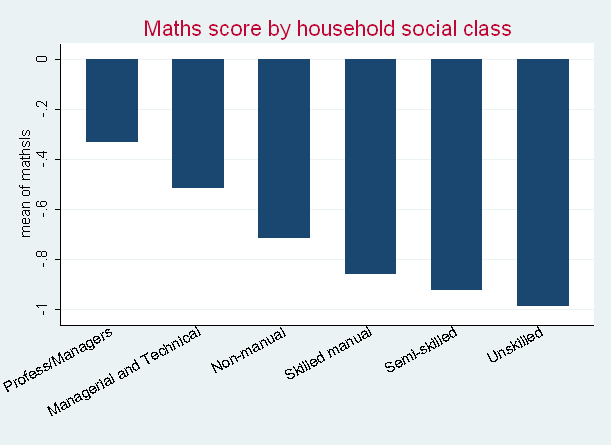
This graphs the mean maths score by household social class and one can clearly see a pronounced association. Social class is based on the highest class of the two parents - if there are two around. Even at age 8 or 9 coming from a professional/managerial household makes a big difference. Alternatively one could look at the education of the primary carer (usually the mother):

Its still the same old story: if your parents have low education then you are at a considerable disadvantage. Doing some simple multivariate modelling, both factors have an independent effect, as does income and other variables. Girls do worse for example though as is well known the reverse seems to be the case when it comes to doing the Leaving Cert.
To get an idea of the magnitudes involved, the mean and standard deviation of the maths test (which is the Drumcondra test) are respectively-0.64 & 0.92 respectively. When one does the regressions one finds that a child of a graduate mother can expect a score that is about .5 higher than a child of a mother with only minimum education (so about 55% of a std dev). For social class the gradient is flatter: the average difference between the top and bottom social classes is about .26. By comparison, the "penalty" to being a girl is 0.1.
Whether the childrens subsequent education exacerbates or reduces this pattern we cannot say. But Jim Heckman, for example, has argued strongly in favour of dynamic complementarities i.e. that learning begets learning which implies that, if anything, early inequalities get worse over time.
So one lesson from all this is I think, that early intervention is necessary if we are serious about addressing socio-economic inequalities in education. Alls we need to do is get serious about it.
Tuesday, August 24, 2010

Innovation Dublin
This year’s Innovation Dublin festival will take place from November 10th – 21st. For those 11 days, venues all over the city region will open their doors to showcase and promote innovation in the city.
From the Innovation Dublin website:
If you or your organization has an innovative idea, product, service, project or performance that you’d like to showcase as part of the festival, be sure submit your event and get involved!
A limited amount of meeting and exhibition space is being made available across the city during the festival – for networking events, exhibitions, talks and debates.
Innovation Dublin
Economic Development Unit,
Dublin City Council,
Civic Offices Wood Quay,
Dublin 8.
From the Innovation Dublin website:
If you or your organization has an innovative idea, product, service, project or performance that you’d like to showcase as part of the festival, be sure submit your event and get involved!
A limited amount of meeting and exhibition space is being made available across the city during the festival – for networking events, exhibitions, talks and debates.
Innovation Dublin
Economic Development Unit,
Dublin City Council,
Civic Offices Wood Quay,
Dublin 8.
Monday, August 23, 2010
First Lisbon Research Workshop on Economics and Econometrics of Education
The aim of this workshop is to provide a forum for presenting and debating current cutting-edge research on the topics of economics and econometrics of education.
Guest Speakers:
* Eric Hanushek (Stanford University)
* Daniele Checchi (University of Milan)
* Brian P. McCall (University of Michigan)
* William Schmidt (Michigan State University)
Topics of Interest:
Authors are invited to submit papers in all areas of economics of education, but preferably with an emphasis on the following topics:
* The role of education/human capital in economic growth
* Determinants of students/schools educational performance
* Education, skills, employability and the labor market
* International comparisons in education
The conference will take place on the 7th and 8th January, 2010. Deadline for paper submissions: October 15, 2010. More details available on the conference website.
Guest Speakers:
* Eric Hanushek (Stanford University)
* Daniele Checchi (University of Milan)
* Brian P. McCall (University of Michigan)
* William Schmidt (Michigan State University)
Topics of Interest:
Authors are invited to submit papers in all areas of economics of education, but preferably with an emphasis on the following topics:
* The role of education/human capital in economic growth
* Determinants of students/schools educational performance
* Education, skills, employability and the labor market
* International comparisons in education
The conference will take place on the 7th and 8th January, 2010. Deadline for paper submissions: October 15, 2010. More details available on the conference website.
Student myopia and the Points Race for university in Ireland
An article in todays Irish Times brings the news that the "points race" for university entrance is back. Of course it never actually went away since there is significant excess demand in general, the number of applicants being about twice the number of places.
However the article does record evidence of a fall in demand for degrees leading to qualifications in sectors hit by the down-turn notably construction (like architecture, civil engineering) and also law. This trend kicked in last year. This makes sense, doesn't it? Well not if you believe human capital theory which says that people choose their education to maximize (discounted) life cycle earnings. Remember by the time this year's university entrants start out on their careers (in 4 or 5 or 6 years time), the worst of the recession will be over. So it looks to me that students are putting far too much weight on current events. Or, more likely, their parents are. Of course other markets, like the stock market which has lots of highly sophisticated, highly paid agents, also display excess volatility. However decisions in that market are taken very very quickly whereas one hopes that decisions about career choice are made in a more sedate fashion.
I wonder is this an argument for moving to an American style system where professional degrees are at graduate level, taken after a fairly general undergraduate degree? At that point, students would make much more mature decisions. It would also remove much of the pressure at the Leaving Certificate level so pedagogy could be focused on actually learning useful skills and not rote-learning and the mindless accumulation of points. It would also help students from low SES backgrounds to access these professions since once they get into university they tend to do okay.
However the article does record evidence of a fall in demand for degrees leading to qualifications in sectors hit by the down-turn notably construction (like architecture, civil engineering) and also law. This trend kicked in last year. This makes sense, doesn't it? Well not if you believe human capital theory which says that people choose their education to maximize (discounted) life cycle earnings. Remember by the time this year's university entrants start out on their careers (in 4 or 5 or 6 years time), the worst of the recession will be over. So it looks to me that students are putting far too much weight on current events. Or, more likely, their parents are. Of course other markets, like the stock market which has lots of highly sophisticated, highly paid agents, also display excess volatility. However decisions in that market are taken very very quickly whereas one hopes that decisions about career choice are made in a more sedate fashion.
I wonder is this an argument for moving to an American style system where professional degrees are at graduate level, taken after a fairly general undergraduate degree? At that point, students would make much more mature decisions. It would also remove much of the pressure at the Leaving Certificate level so pedagogy could be focused on actually learning useful skills and not rote-learning and the mindless accumulation of points. It would also help students from low SES backgrounds to access these professions since once they get into university they tend to do okay.
Sunday, August 22, 2010
NBER: On the importance of stimulus delivery mechanism
Check in the Mail or More in the Paycheck: Does the Effectiveness of Fiscal Stimulus Depend on How It Is Delivered?
Claudia R. Sahm, Matthew D. Shapiro, Joel Slemrod
NBER Working Paper No. 16246
Issued in July 20
Recent fiscal policies have aimed to stimulate household spending. In 2008, most households received one-time economic stimulus payments. In 2009, most working households received the Making Work Pay tax credit in the form of reduced withholding; other households, mainly retirees, received one-time payments. This paper quantifies the spending response to these different policies and examines whether the spending response differed according to whether the stimulus was delivered as a one-time payment or as a flow of payments in the form of reduced withholding. Based on responses from a representative sample of households in the Thomson Reuters/University of Michigan Surveys of Consumers, the paper finds that the reduction in withholding led to a substantially lower rate of spending than the one-time payments. Specifically, 25 percent of households reported that the one-time economic stimulus payment in 2008 led them to mostly increase their spending while only 13 percent reported that the extra pay from the lower withholding in 2009 led them to mostly increase their spending. The paper uses several approaches to isolate the effect of the delivery mechanism from the changing aggregate and individual conditions. Responses to a hypothetical stimulus in 2009, examination of “free responses” concerning differing responses to the policies, and regression analysis controlling for individual economic conditions and demographics all support the primary importance of the income delivery mechanism in determining the spending response to the policies.
Claudia R. Sahm, Matthew D. Shapiro, Joel Slemrod
NBER Working Paper No. 16246
Issued in July 20
Recent fiscal policies have aimed to stimulate household spending. In 2008, most households received one-time economic stimulus payments. In 2009, most working households received the Making Work Pay tax credit in the form of reduced withholding; other households, mainly retirees, received one-time payments. This paper quantifies the spending response to these different policies and examines whether the spending response differed according to whether the stimulus was delivered as a one-time payment or as a flow of payments in the form of reduced withholding. Based on responses from a representative sample of households in the Thomson Reuters/University of Michigan Surveys of Consumers, the paper finds that the reduction in withholding led to a substantially lower rate of spending than the one-time payments. Specifically, 25 percent of households reported that the one-time economic stimulus payment in 2008 led them to mostly increase their spending while only 13 percent reported that the extra pay from the lower withholding in 2009 led them to mostly increase their spending. The paper uses several approaches to isolate the effect of the delivery mechanism from the changing aggregate and individual conditions. Responses to a hypothetical stimulus in 2009, examination of “free responses” concerning differing responses to the policies, and regression analysis controlling for individual economic conditions and demographics all support the primary importance of the income delivery mechanism in determining the spending response to the policies.
Saturday, August 21, 2010
Behavioural Economics in Song - Sit Down
"Now I've swung back down again, its worse than it was before. If I hadn't seen such riches I could live with being poor."
Washington Institute for Health Metrics and Evaluation Datasets
Students and researchers should keep a close eye on the evolving data infrastructure at the Institute for Health Metrics and Evaluation at University of Washington. The Maternal Mortality data page here is an example. Many of these data-sets were constructed for large scale evaluations of public health initiatives developed with a view to the Millenium Development Goals. They are very useful resources also for development economists and do not yet seem to have been widely used in this area. They are also, for the most part, downloadable for free in a "one-click" excel format. The growing publication list of this Institute is also worth looking at carefully.
I-Phone Apps
If anyone has developed decent i-phone apps for doing surveys, please feel free to get in contact or put them on the comments section. At present, we are in the process of developing one for helping us conduct time discounting and related studies here in the Institute. I linked recently to the Mappiness app and I know a number of readers of the blog who started using it. The main barrier to using iphone apps at present is, of course, the limited penetration of iphones. However, as someone who has engaged in every conceivable form of survey work it is obvious to me that, if cost were not an issue, that the iphone is practically a perfect mode for conducting behavioural economics research and I am very interested to see the types of things that people develop. We are beginning work on an app that will work on any smart phone and will be used as an ajdunct to our internet survey panel work. This is still very limited in terms of coverage but a leap forward in terms of being able to do the type of experimental research "in the wild" that is really needed to develop empirical behavioural economics research.
Height and Selective Mortality
Empoverished early conditions affect stature through a variety of channels. In general we expect that people who grow up in environments with inadaquate nutrition, poor sanitation and so on to be shorter. Recent evidence from global surveys bears this out. However, a number of papers find that African countries in general deviate from expected heights. This is most clearly shown in a 2007 PNAS paper by Angus Deaton. Deaton's conclusion is an important one for people using height as an adult indicator of stressed early childhoods:
Steckel, Richard H.
Additional information is available for the following registered author(s):
Since 1995 approximately 325 publications on stature have appeared in the social sciences, which is more than a four-fold increase in the rate of production relative to the period 1977-1994. The expansion occurred in several areas, but especially within economics, indicating that heights are now widely accepted as useful measure of human welfare. Much of this new work extends beyond the traditional bailiwick of anthropometric history, including biological welfare during economic and political crises; anthropometric determinants of wages; the welfare of women relative to men in the contemporary world; the fetal origins hypothesis; and inequality in the developing world. The approach has also expanded within economic history to consider the consequences of empire for colonials; the health of populations lacking traditional measures of social performance; the consequences of smallpox; and very long-term trends in health. Much has also been learned about socioeconomic aspects of inequality, the welfare implications of industrialization, and socioeconomic determinants of stature. The last is a work in progress and one may doubt whether sufficient longitudinal evidence will become available for a complete understanding of the variety and strength of pathways that affect human physical growth.
This paper investigates the environmental determinants of height across 43 developing countries. Unlike in rich countries, where adult height is well predicted by mortality in infancy, there is no consistent relationship across and within countries between adult height on the one hand and childhood mortality or living conditions on the other. In particular, adult African women are taller than is warranted by their low incomes and high childhood mortality, not to mention their mothers' educational level and reported nutrition. High childhood mortality in Africa is associated with taller adults, which suggests that mortality selection dominates scarring, the opposite of what is found in the rest of the world.A recent review by Steckel is worth reading in terms of the considerations that should be employed when using height data:
Heights and human welfare: Recent developments and new directions
Author info | Abstract | Publisher info | Download info | Related research | Statistics| Author Info |
Additional information is available for the following registered author(s):
| Abstract |
Since 1995 approximately 325 publications on stature have appeared in the social sciences, which is more than a four-fold increase in the rate of production relative to the period 1977-1994. The expansion occurred in several areas, but especially within economics, indicating that heights are now widely accepted as useful measure of human welfare. Much of this new work extends beyond the traditional bailiwick of anthropometric history, including biological welfare during economic and political crises; anthropometric determinants of wages; the welfare of women relative to men in the contemporary world; the fetal origins hypothesis; and inequality in the developing world. The approach has also expanded within economic history to consider the consequences of empire for colonials; the health of populations lacking traditional measures of social performance; the consequences of smallpox; and very long-term trends in health. Much has also been learned about socioeconomic aspects of inequality, the welfare implications of industrialization, and socioeconomic determinants of stature. The last is a work in progress and one may doubt whether sufficient longitudinal evidence will become available for a complete understanding of the variety and strength of pathways that affect human physical growth.
Friday, August 20, 2010
Registering Deaths in Japan
The issue of incentives for registering births and deaths, in general, is a tricky issue for research on historical health conditions. This story on the BBC website caught my eye today. The Japanese authorities are effectively trying to clean up their own data-bases by tracking down the many people they have listed on their books who are 100 years old or more. I am sure many of them will turn out to be sprightly old people who have obeyed a regimine of oily fish and exercise for their life time. However, it seems that some of them are actually long dead, including one lady whose bones were found in a rucksack and another person whose registered address was bulldozed 20 years ago. At least one potential reason for the prevalance of centenarians is that their benefits can still be claimed after their death by unscrupulous relatives.
Consideration of future consequences
Consideration of future consequences scale: Confirmatory Factor Analysis
D. Hevey, M. Pertl, K. Thomas, L. Maher, A. Craig and S. Ni Chuinneagain
Trinity College Dublin, Dublin 2, Ireland
Personality and Individual Differences
Volume 48, Issue 5, April 2010, Pages 654-657
Abstract:
Individual differences in the Consideration of Future Consequences (CFC) are typically assessed using the 12-item scale developed by Strathman, Gleicher, Boninger, and Edwards (1994). However, in contrast to the unidimensional model proposed by the scale developers, recent factor analyses have produced two-dimensional models of the scale. Confirmatory factor analyses were used in this study to evaluate different 1- and 2-factor models based on data provided by 590 (236 males, 354 females) young adult members of the general public. Although some alternative models showed promise, the 12-item single factor model with method effects associated with positively and negatively worded items provided best fit. Implications for the assessment of CFC are considered.
Keywords: Consideration of future consequences; Confirmatory Factor Analysis; Method effects
D. Hevey, M. Pertl, K. Thomas, L. Maher, A. Craig and S. Ni Chuinneagain
Trinity College Dublin, Dublin 2, Ireland
Personality and Individual Differences
Volume 48, Issue 5, April 2010, Pages 654-657
Abstract:
Individual differences in the Consideration of Future Consequences (CFC) are typically assessed using the 12-item scale developed by Strathman, Gleicher, Boninger, and Edwards (1994). However, in contrast to the unidimensional model proposed by the scale developers, recent factor analyses have produced two-dimensional models of the scale. Confirmatory factor analyses were used in this study to evaluate different 1- and 2-factor models based on data provided by 590 (236 males, 354 females) young adult members of the general public. Although some alternative models showed promise, the 12-item single factor model with method effects associated with positively and negatively worded items provided best fit. Implications for the assessment of CFC are considered.
Keywords: Consideration of future consequences; Confirmatory Factor Analysis; Method effects
Boys just want to have fun?
RTE today carried the shock news that girls outperform boys in the Leaving Certificate. To be fair the article notes that this is not new and is observed internationally. What I am not aware of is evidence (and no, anecdotes - even from taxi-drivers- do not count) on why this is so.
There is no shortage of theories of course: the feminization of teaching, the feeling of displacement and general uselessness by males due to the evils of feminism etc etc. But this seems an important enough trend to be worth studying and, even, doing something about.
There is no shortage of theories of course: the feminization of teaching, the feeling of displacement and general uselessness by males due to the evils of feminism etc etc. But this seems an important enough trend to be worth studying and, even, doing something about.
Wednesday, August 18, 2010
Graduate Unemployment
I can't find the release on the HEA website, but a story in the Irish Times from Saturday states that "fewer than half of undergraduates who completed degrees in 2009 are employed, according to provisional figures from the Higher Education Authority. The initial findings of a HEA survey indicate that 45 per cent of those who graduated last year are in employment, while 43 per cent have gone on to further education." The Irish Times article also says: "According to CSO figures, in March 2010 there were just over 59,000 unemployed graduates in Ireland." On Saturday's Mariane Finucane show on RTE Radio 1, Charlie Bird stepped into the presenter's seat and spoke to a number of recent college graduates about their plans for the future.
A Reminder About The Dangers of Interpreting Interaction Effects in Non-Linear Models
"The magnitude of the interaction effect in nonlinear models does not equal the marginal effect of the interaction term, can be of opposite sign, and its statistical significance is not calculated by standard software. We present the correct way to estimate the magnitude and standard errors of the interaction effect in nonlinear models."
Ai, Chunrong & Norton, Edward C., 2003. "Interaction terms in logit and probit models," Economics Letters, Elsevier, vol. 80(1), pages 123-129, July.
The Stata programme inteff is recommended.
Ai, Chunrong & Norton, Edward C., 2003. "Interaction terms in logit and probit models," Economics Letters, Elsevier, vol. 80(1), pages 123-129, July.
The Stata programme inteff is recommended.
Tuesday, August 17, 2010
Ashraf, Fink and Weil - Evaluating the Effects of Large Scale Health Interventions
Evaluating the Effects of Large Scale Health Interventions in Developing Countries: The Zambian Malaria Initiative
Author info | Abstract | Publisher info | Download info | Related research | Statistics| Author Info |
Günther Fink
David N. Weil
Additional information is available for the following registered author(s):
| Abstract |
Since 2003, Zambia has been engaged in a large-scale, centrally coordinated national anti-Malaria campaign which has become a model in sub-Saharan Africa. This paper aims at quantifying the individual and macro level benefits of this campaign, which involved mass distribution of insecticide treated mosquito nets, intermittent preventive treatment for pregnant women, indoor residual spraying, rapid diagnostic tests, and artemisinin-based combination therapy. We discuss the timing and regional coverage of the program, and critically review the available health and program rollout data. To estimate the health benefits associated with the program rollout, we use both population based morbidity measures from the Demographic and Health Surveys and health facility based mortality data as reported in the national Health Management Information System. While we find rather robust correlations between the rollout of bed nets and subsequent improvements in our health measures, the link between regional spraying and individual level health appears rather weak in the data.
November 23rd; Economics, Psychology and Neuroscience One day Event
The third in our series of one-day events on economics, psychology and neuroscience will be run here in UCD on November 23rd. Professor David Laibson of Harvard, a global thought leader in this area, will be giving the keynote lecture. As in previous years there will be several talks throughout the day. Other speakers confirmed so far include myself, Robert Metcalfe from Oxford and Peter Lunn from ESRI. Please let me know if you would like to present a paper at this. PhD students welcome. The main purpose of the event is to provide a national platform for research at the interface of economics, psychology and neuroscience. Last year's event was extremely energetic with a keynote talk from Arie Kapteyn and several interesting sessions throughout the day.
How big really?
A new BBC website allows you to map notable events on to your local area. It's designed to "bring home the human scale of events and places in history". It's another interesting way of representing information.
Monday, August 16, 2010
Cunha and Heckman IZA Paper - Investing in Young People
Investing in Our Young People
by Flavio Cunha, James J. Heckman
(July 2010)
Abstract:
This paper reviews the recent literature on the production of skills of young persons. The literature features the multiplicity of skills that explain success in a variety of life outcomes. Noncognitive skills play a fundamental role in successful lives. The dynamics of skill formation reveal the interplay of cognitive and noncognitive skills, and the presence of critical and sensitive periods in the life-cycle. We discuss the optimal timing of investment over the life-cycle.
Text: See Discussion Paper No. 5050
by Flavio Cunha, James J. Heckman
(July 2010)
Abstract:
This paper reviews the recent literature on the production of skills of young persons. The literature features the multiplicity of skills that explain success in a variety of life outcomes. Noncognitive skills play a fundamental role in successful lives. The dynamics of skill formation reveal the interplay of cognitive and noncognitive skills, and the presence of critical and sensitive periods in the life-cycle. We discuss the optimal timing of investment over the life-cycle.
Text: See Discussion Paper No. 5050
The Irish and America's Law and Order Problem
Immigration: America's nineteenth century "law and order problem"?
New NBER Working Paper No. 16266
Howard Bodenhorn, Carolyn M. Moehling, Anne Morrison Piehl
Issued in August 2010
Past studies of the empirical relationship between immigration and crime during the first major wave of immigration have focused on violent crime in cities and have relied on data with serious limitations regarding nativity information. We analyze administrative data from Pennsylvania prisons, with high quality information on nativity and demographic characteristics. The latter allow us to construct incarceration rates for detailed population groups using U.S. Census data. The raw gap in incarceration rates for the foreign and native born is large, in accord with the extremely high concern at the time about immigrant criminality. But adjusting for age and gender greatly narrows that observed gap. Particularly striking are the urban/rural differences. Immigrants were concentrated in large cities where reported crime rates were higher. However, within rural counties, the foreign born had much higher incarceration rates than the native born. The interaction of nativity with urban residence explains much of the observed aggregate differentials in incarceration rates. Finally, we find that the foreign born, especially the Irish, consistently have higher incarceration rates for violent crimes, but from 1850 to 1860 the natives largely closed the gap with the foreign born for property offenses.
Howard Bodenhorn, Carolyn M. Moehling, Anne Morrison Piehl
Issued in August 2010
Past studies of the empirical relationship between immigration and crime during the first major wave of immigration have focused on violent crime in cities and have relied on data with serious limitations regarding nativity information. We analyze administrative data from Pennsylvania prisons, with high quality information on nativity and demographic characteristics. The latter allow us to construct incarceration rates for detailed population groups using U.S. Census data. The raw gap in incarceration rates for the foreign and native born is large, in accord with the extremely high concern at the time about immigrant criminality. But adjusting for age and gender greatly narrows that observed gap. Particularly striking are the urban/rural differences. Immigrants were concentrated in large cities where reported crime rates were higher. However, within rural counties, the foreign born had much higher incarceration rates than the native born. The interaction of nativity with urban residence explains much of the observed aggregate differentials in incarceration rates. Finally, we find that the foreign born, especially the Irish, consistently have higher incarceration rates for violent crimes, but from 1850 to 1860 the natives largely closed the gap with the foreign born for property offenses.
IZA Workshop: Cognitive and Non-Cognitive Skills
From the workshop website:
Organizers: Steffen Altmann (IZA), Armin Falk (University of Bonn and IZA)
Place: IZA, Bonn
Date: January 25 - January 27, 2011
Submission Deadline: October 15, 2010
Notification of Acceptance: November 15, 2010
Complete Papers Due: December 31, 2010
The workshop will bring together leading scholars and young researchers pursuing research at the intersection of economics, psychology, and biology. Acknowledging the importance of interdisciplinary research for understanding the foundations and development of cognitive and non-cognitive skills, we invite contributions from various methodological backgrounds: theoretical contributions as well as empirical research using field data, experiments, or neuroeconomic methods.
# Topics of the workshop will include (but are not limited to): Measurement of cognitive and non-cognitive skills
# Skill formation during the life-cycle
# Economic and social consequences of (non-) cognitive skills
# Economic, biological, psychological and environmental determinants of skills
# Policy interventions to enhance skill formation, particularly during early childhood
A highlight of the meeting is the Keynote Lecture which will be held by James J. Heckman (University of Chicago and IZA).
The conference and lodging will be free of charge for presenters, and travel expenses will be reimbursed according to IZA travel guidelines.
Organizers: Steffen Altmann (IZA), Armin Falk (University of Bonn and IZA)
Place: IZA, Bonn
Date: January 25 - January 27, 2011
Submission Deadline: October 15, 2010
Notification of Acceptance: November 15, 2010
Complete Papers Due: December 31, 2010
The workshop will bring together leading scholars and young researchers pursuing research at the intersection of economics, psychology, and biology. Acknowledging the importance of interdisciplinary research for understanding the foundations and development of cognitive and non-cognitive skills, we invite contributions from various methodological backgrounds: theoretical contributions as well as empirical research using field data, experiments, or neuroeconomic methods.
# Topics of the workshop will include (but are not limited to): Measurement of cognitive and non-cognitive skills
# Skill formation during the life-cycle
# Economic and social consequences of (non-) cognitive skills
# Economic, biological, psychological and environmental determinants of skills
# Policy interventions to enhance skill formation, particularly during early childhood
A highlight of the meeting is the Keynote Lecture which will be held by James J. Heckman (University of Chicago and IZA).
The conference and lodging will be free of charge for presenters, and travel expenses will be reimbursed according to IZA travel guidelines.
Matching Methods for Causal Inference: A Review and a Look Forward
Author: Elizabeth A. Stuart
Source: Statist. Sci. Volume 25, Number 1 (2010), 1-21
Abstract:
Source: Statist. Sci. Volume 25, Number 1 (2010), 1-21
Abstract:
When estimating causal effects using observational data, it is desirable to replicate a randomized experiment as closely as possible by obtaining treated and control groups with similar covariate distributions. This goal can often be achieved by choosing well-matched samples of the original treated and control groups, thereby reducing bias due to the covariates. Since the 1970s, work on matching methods has examined how to best choose treated and control subjects for comparison. Matching methods are gaining popularity in fields such as economics, epidemiology, medicine and political science. However, until now the literature and related advice has been scattered across disciplines. Researchers who are interested in using matching methods—or developing methods related to matching—do not have a single place to turn to learn about past and current research. This paper provides a structure for thinking about matching methods and guidance on their use, coalescing the existing research (both old and new) and providing a summary of where the literature on matching methods is now and where it should be headed.Keywords: Observational study; propensity scores; subclassification; weighting
Sunday, August 15, 2010
Interview on Global Irish
Via Colm, here is a link to an interview with Elizabeth Malcolm on the reasons for Irish migration throughout history and the effect the Irish had on various countries.
IZA Working Paper: Strategic Behavior across Gender: A Comparison of Female and Male Expert Chess Players
IZA DP No. 4793
Strategic Behavior across Gender: A Comparison of Female and Male Expert Chess Players
Christer Gerdes and Patrik Gränsmark
February 2010
This paper aims to measure differences in risk behavior among expert chess players. The study employs a panel data set on international chess with 1.4 million games recorded over a period of 11 years. The structure of the data set allows us to use individual fixed-effect estimations to control for aspects such as innate ability as well as other characteristics of the players. Most notably, the data contains an objective measure of individual playing strength, the so-called Elo rating. In line with previous research, we find that women are more risk averse than men. A novel finding is that males choose more aggressive strategies when playing against female opponents even though such strategies reduce their winning probability.
Strategic Behavior across Gender: A Comparison of Female and Male Expert Chess Players
Christer Gerdes and Patrik Gränsmark
February 2010
This paper aims to measure differences in risk behavior among expert chess players. The study employs a panel data set on international chess with 1.4 million games recorded over a period of 11 years. The structure of the data set allows us to use individual fixed-effect estimations to control for aspects such as innate ability as well as other characteristics of the players. Most notably, the data contains an objective measure of individual playing strength, the so-called Elo rating. In line with previous research, we find that women are more risk averse than men. A novel finding is that males choose more aggressive strategies when playing against female opponents even though such strategies reduce their winning probability.
Saturday, August 14, 2010
Historical Sample of the Netherlands
I have talked a lot about the Dutch LISS Panel as being one of the world's most useful data resource for social science. It has been nominated for a Dutch award for data dissemination. Along with it was nominated the eventual winner, the Historical Sample of the Netherlands. This is a mindblowing data infrastructure. From their website "The HSN offers a representative sample of about 78,000 people born in the Netherlands during the period 1812-1922. The HSN-database containing individual life-courses is a unique tool for research in Dutch history and demography." It is well worth a browse through the projects and data that is linked on their site.
The following project is one example of how they are using the data.
The following project is one example of how they are using the data.
The project 'Early Life Conditions, Social Mobility and Longevity' (ESM) is an international project, supervised by prof. George Alter (Indiana University, Bloomington), and for the main part financed by the National Institute of Aging (National Institute of Health, Washington D.C.). The Dutch part is carried out by dr. F.W.A. van Poppel, from the Netherlands Interdisciplinary Demographic Institute (NIDI). The cooperation with the HSN consists of building the database 'Inequality and longevity from a life-course perspective: the Netherlands 1850-2000'.
Based on this database the long-term effects of social, economical and familial conditions during childhood on mortality in later life will be studied. Using population registers, personal cards and records of the civil registration, life courses and family compositions will be reconstructed for about 7000 children, born between 1850-1922 in the provinces of Utrecht, Zeeland and Friesland. Context variables, like the regional level of water supplies, mortality and family income, are also part of the analysis.
Graduate Students
Graduate students getting a rough time on televison again! Thanks to Fearghal for the link.
Friday, August 13, 2010
Parental Education, Grade Attainment and Earnings Expectations
Parental Education, Grade Attainment and Earnings Expectations
Liam Delaney (UCD Geary Institute, University College Dublin; School of Economics, University College Dublin; School of Public Health and Population Science, University College Dublin)
Colm Harmon (UCD Geary Institute, University College Dublin; School of Economics, University College Dublin; IZA, Bonn)
Cathy Redmond (UCD Geary Institute, University College Dublin)
While there is an extensive literature on intergenerational transmission of economic outcomes (education, health and income for example), many of the pathways through which these outcomes are transmitted are not as well understood. We address this deficit by analysing the relationship between socio-economic status and child outcomes in university, based on a rich and unique dataset of university students. While large socio-economic differences in academic performance exist at the point of entry into university, these differences are substantially narrowed during the period of study. Importantly, the differences across socio-economic backgrounds in university grade attainment for female students is explained by intermediating variables such as personality, risk attitudes and time preferences, and subject/college choices. However, for male students, we explain less than half of the socio-economic gradient through these same pathways. Despite the weakening socio-economic effect in grade attainment, a key finding is that large socio-economic differentials in the earnings expectations of university students persist, even when controlling for grades in addition to our rich set of controls. Our findings pose a sizable challenge for policy in this area as they suggest that equalising educational outcomes may not translate into equal labour market outcomes.
Liam Delaney (UCD Geary Institute, University College Dublin; School of Economics, University College Dublin; School of Public Health and Population Science, University College Dublin)
Colm Harmon (UCD Geary Institute, University College Dublin; School of Economics, University College Dublin; IZA, Bonn)
Cathy Redmond (UCD Geary Institute, University College Dublin)
While there is an extensive literature on intergenerational transmission of economic outcomes (education, health and income for example), many of the pathways through which these outcomes are transmitted are not as well understood. We address this deficit by analysing the relationship between socio-economic status and child outcomes in university, based on a rich and unique dataset of university students. While large socio-economic differences in academic performance exist at the point of entry into university, these differences are substantially narrowed during the period of study. Importantly, the differences across socio-economic backgrounds in university grade attainment for female students is explained by intermediating variables such as personality, risk attitudes and time preferences, and subject/college choices. However, for male students, we explain less than half of the socio-economic gradient through these same pathways. Despite the weakening socio-economic effect in grade attainment, a key finding is that large socio-economic differentials in the earnings expectations of university students persist, even when controlling for grades in addition to our rich set of controls. Our findings pose a sizable challenge for policy in this area as they suggest that equalising educational outcomes may not translate into equal labour market outcomes.
Thursday, August 12, 2010
NSF:SBE 2020 - Future Research in the Social, Behavioral & Economic Sciences
NSF: SBE (National Science Foundation: Social, Behavioural and Economic Sciences) invites individuals and groups to contribute white papers outlining grand challenge questions that are both foundational and transformative. More details are available here.
NSF: SBE expect these white papers to advance SBE’s mission to study human characteristics and human behaviors in its Social and Economic Sciences and Behavioral and Cognitive Sciences divisions, as well as to be the nation’s resource for understanding the structure and development of science through its Science Resources Statistics division.
White papers should address the following questions:
1. What is the fundamental question/questions? And why is this important? Explain the challenge question, capability to be created, or scientific strategy; provide context in terms of recent research results and standing questions in the field; and suggest the range of disciplines that may contribute.
2. What are the implications for advancing the domain? For building capacity? And for providing infrastructure? By “advancing the domain,” we mean the fundamental science; by “capacity” we mean education and training of graduate students, faculty, and systems of prestige, promotion, and recognition; and by “infrastructure”, we mean the shared data and systems that enable the research (e.g., large survey data sets, research centers, shared toolkits and so on).
3. Who is doing provocative research?
4. What other questions should SBE ask as responses are analyzed?
Respondents must answer (1) and (2); they are encouraged to answer (3) and (4). A white paper should have no more than 2,000 words, and should be submitted by September 30, 2010.
NSF: SBE expect these white papers to advance SBE’s mission to study human characteristics and human behaviors in its Social and Economic Sciences and Behavioral and Cognitive Sciences divisions, as well as to be the nation’s resource for understanding the structure and development of science through its Science Resources Statistics division.
White papers should address the following questions:
1. What is the fundamental question/questions? And why is this important? Explain the challenge question, capability to be created, or scientific strategy; provide context in terms of recent research results and standing questions in the field; and suggest the range of disciplines that may contribute.
2. What are the implications for advancing the domain? For building capacity? And for providing infrastructure? By “advancing the domain,” we mean the fundamental science; by “capacity” we mean education and training of graduate students, faculty, and systems of prestige, promotion, and recognition; and by “infrastructure”, we mean the shared data and systems that enable the research (e.g., large survey data sets, research centers, shared toolkits and so on).
3. Who is doing provocative research?
4. What other questions should SBE ask as responses are analyzed?
Respondents must answer (1) and (2); they are encouraged to answer (3) and (4). A white paper should have no more than 2,000 words, and should be submitted by September 30, 2010.
Wednesday, August 11, 2010
NBER - Sadness, Suicidality and Grades
Sadness, Suicidality and Grade
K) | Jeffrey S. DeSimoneNBER Working Paper No. 16239July 2010 This study examines the past year relationship between GPA and experiencing a combination of two primary depression symptoms, feeling sad and losing interest in usual activities for at least two consecutive weeks, among high school students during 2001–2009. The GPA loss associated with sadness, as defined above, falls from slightly less than a plus/minus mark to around 0.1 point when commonly co-occurring behaviors are held constant. Nonetheless, this effect is significantly larger than those of having considered or planned suicide and equivalent to having attempted suicide, which seemingly signify more severe depression. Moreover, sadness lowers the probability of earning A grades, and raises that of receiving grades of C or below, by over 15%. Coefficient sizes are similar when comparison groups are restricted to students engaging in correlated behaviors and in matching and instrumental variable models, suggesting that sadness causally reduces academic performance. |
Analysing Social Experiments - Heckman
Analyzing Social Experiments as Implemented: A Reexamination of the Evidence From the HighScope Perry Preschool Program
Author info | Abstract | Publisher info | Download info | Related research | Statistics| Author Info |
Seong Hyeok Moon (Department of Economics, University of Chicago)
Rodrigo Pinto (Department of Economics, University of Chicago)
Peter A. Savelyev (Department of Economics, University of Chicago)
Adam Yavitz (Economic Research Center, University of Chicago)
| Abstract |
Social experiments are powerful sources of information about the effectiveness of interventions. In practice, initial randomization plans are almost always compromised. Multiple hypotheses are frequently tested. "Signicant" effects are often reported with p-values that do not account for preliminary screening from a large candidate pool of possible effects. This paper develops tools for analyzing data from experiments as they are actually implemented. We apply these tools to analyze the influential HighScope Perry Preschool Program. The Perry program was a social experiment that provided preschool education and home visits to disadvantaged children during their preschool years. It was evaluated by the method of random assignment. Both treatments and controls have been followed from age 3 through age 40. Previous analyses of the Perry data assume that the planned randomization protocol was implemented. In fact, as in many social experiments, the intended randomization protocol was compromised. Accounting for compromised randomization, multiple-hypothesis testing, and small sample sizes, we find statistically significant and economically important program effects for both males and females. We also examine the representativeness of the Perry study.
Tuesday, August 10, 2010
Mental Health and Labour Market Participation
Mental Health and Labour Market Participation: Evidence from IV Panel Data Models
Author info | Abstract | Publisher info | Download info | Related research | Statistics| Author Info |
Johnston, David W. (dwjohnston@qut.edu.au) (Queensland University of Technology)
Shields, Michael A. (mshields@unimelb.edu.au) (University of Melbourne)
Additional information is available for the following registered author(s):
| Abstract |
A large body of empirical research links mental health and labour market outcomes; however, there are few studies that effectively control for the two-way causality between work and health and the existence of unobserved individual characteristics that might jointly determine health and labour market outcomes. In this study, we estimate the effect of mental health on labour market participation using various models, including instrumental variable models that exploit individual variation observed in panel data. We find robust evidence that a reduction in mental health has a substantial negative impact on the probability of actively participating in the labour market. We calculate that a one standard deviation decrease in mental health decreases the probability of participation by around 17 percentage points. This effect is larger for females and for older individuals. We therefore provide robust evidence that there are substantial costs due to the lost productivity resulting from poor mental health.
Childhood Economic Conditions and Length of Life - Evidence from Boyd-Orr Cohort
Childhood economic conditions and length of life: Evidence from the UK Boyd Orr cohort, 1937-2005
Author info | Abstract | Publisher info | Download info | Related research | Statistics| Author Info |
Hatton, Timothy J.
Martin, Richard M.
Shields, Michael A.
Additional information is available for the following registered author(s):
| Abstract |
We study the importance of childhood socioeconomic conditions in predicting differences in life expectancy using data from a large sample of children collected in 16 locations in England and Scotland in 1937-39, who have been traced through official death records up to 2005. We estimate a number of duration of life models that control for unobserved family heterogeneity. Our results confirm that childhood conditions such as household income and the quality of the home environment are significant predictors of longevity. Importantly, however, the role of socioeconomic status appears to differ across cause of death, with household income being a significant predictor of death from smoking-related cancer. Moreover, we find that (1) poor housing conditions in childhood is associated with reduced longevity, that (2) early doctor-assessed childhood health conditions significantly predict a reduced length of life, that (3) children born in a location with relatively high infant mortality rates live significantly fewer years, and that (4) there is a high correlation in longevity across children from the same family across all causes of death. We estimate that the difference in life expectancy between those with the [`]best' and [`]worst' observable characteristics is about 9 years, which increases to 20 years when we take into account the [`]best' and [`]worst' observable and unobservable household characteristics.
Boyd-Orr Cohort Study
Hatton and Martin - Poverty and Stature for British Children in the 1930s
The effects on stature of poverty, family size, and birth order: British children in the 1930s
Author info | Abstract | Publisher info | Download info | Related research | Statistics| Author Info |
Richard M. Martin
Additional information is available for the following registered author(s):
| Abstract |
This article examines the effects of socio-economic conditions on the standardized heights and body mass index (BMI) of children in Interwar Britain, using the Boyd Orr cohort, a survey of predominantly poor families taken in 1937--9. We examine the trade-off between child quality (in the form of health outcomes) and the number of children in the family. We find that birth order and family size have negative effects on the heights of children, but not on their BMI. Household income per capita positively influences height but, even after accounting for this, the number of children in the family has a negative effect on height. This latter effect is closely associated with overcrowding and with the degree of cleanliness or hygiene in the household, which conditions exposure to factors predisposing to disease. We also analyse follow-up data, which indicates that the effects of family size on height persisted into adulthood. Copyright 2010 Oxford University Press 2009 All rights reserved, Oxford University Press.
Monday, August 09, 2010
Does It Matter What We Do?
I read today on the Irish Independent website that "the Dublin Institute of Technology is scrambling to create 900 extra college places next month, following a surprise €3m invitation from the Department of Education and Skills. At least half a dozen other colleges have also been contacted within the past few days to run degree, diploma and other courses for jobless adults." Upon further investigation I found this press release (5th August) on the Dept. of Education and Skills website, which documents the allocation of an additional €12 million to the Labour Market Activation Fund. "The additional funding will support education and training programmes for at least 5,000 additional unemployed people and will bring the total number of participant places supported by the Fund to over 11,000 this year."
A fair question is whether education and training programmes are the best use of any available funds. Getting one of these places is undoubtedly a positive experience for the 11,000 (potential) participants, notwithstanding the fact that education and training do not guarantee subsequent employment in current labour market conditions. Those conditions worsened last week: the July Live Register figures reached 418,100 (seasonally adjusted); that is 38 times the 11,000 places on this year's training programmes. Last week's Live Register figures correspond to an increase in the seasonally adjusted standardised unemployment rate from 13.4% in June to 13.7% in July. This is the worst unemployment figure to date since the Irish labour market collapsed in 2008.
Beyond whether education and training programmes are the best use of any available funds, there is also the wider question of what will really contribute to reducing unemployment? The other Government policies in this arena have been flagged by me before: Employment Subsidy Scheme, Revised Work Placement Programme, New Activation Fund and changes to the jobseeker’s allowance and supplementary welfare allowance schemes. The Employment Subsidy Scheme does not reduce unemployment; it is about retaining jobs that might otherwise be made redundant. The Work Placement Programme (WPP) has a maximum duration of 9 months. While participating in the WPP may make participants more employable, there is no guarantee for subsequent employment in current labour market conditions.
As with the education and training programmes, the WPP serves to make unemployed individuals more employable, but does nothing to improve labour market conditions. Last year's changes to the Jobseeker’s Allowance and Supplementary Welfare Allowance may seem quite harsh, but reservation wages may currently be too high. This is an area that at least deserves more research. Here is an IZA working paper from 2008 that discusses the relationship between unemployment benefits and reservation wages. It is also worth reflecting on how we might expect this relationship to change over a boom-bust economic cycle. I am not recommending any particular policy here. I simply want to highlight the importance of labour market conditions for employment-growth, and to pose the question: 'Does It Matter What We Do?' A recent YouTube video from ChicagoBusiness.com (shown below) depicts the Illinois unemployment rate in a cartoon. It ends with the tagline: "It doesn't matter what I do... I just keep gaining!!!"
In closing, I do think it matters what we do; and that we can do better. On a previous occasion Liam drew my attention to a Forbes article by Chicago economist Steven J Davis, which outlined ideas to reduce unemployment. My interpretation of the Davis approach is to temporarily reduce the extent of labour market regulations: to make it cheaper for employers to start hiring again. As Kevin has noted before, a lot of the evidence around cutting the minimum wage, tightening the benefit system and monitoring search effort more closely may come from economies that are closer to the equilibrium rate (of unemployment). However, I still think this evidence is worth examining. One place to start is the Nickell, Nunziata and Ockel paper (Economic Journal, 2005); abstract below:
A fair question is whether education and training programmes are the best use of any available funds. Getting one of these places is undoubtedly a positive experience for the 11,000 (potential) participants, notwithstanding the fact that education and training do not guarantee subsequent employment in current labour market conditions. Those conditions worsened last week: the July Live Register figures reached 418,100 (seasonally adjusted); that is 38 times the 11,000 places on this year's training programmes. Last week's Live Register figures correspond to an increase in the seasonally adjusted standardised unemployment rate from 13.4% in June to 13.7% in July. This is the worst unemployment figure to date since the Irish labour market collapsed in 2008.
Beyond whether education and training programmes are the best use of any available funds, there is also the wider question of what will really contribute to reducing unemployment? The other Government policies in this arena have been flagged by me before: Employment Subsidy Scheme, Revised Work Placement Programme, New Activation Fund and changes to the jobseeker’s allowance and supplementary welfare allowance schemes. The Employment Subsidy Scheme does not reduce unemployment; it is about retaining jobs that might otherwise be made redundant. The Work Placement Programme (WPP) has a maximum duration of 9 months. While participating in the WPP may make participants more employable, there is no guarantee for subsequent employment in current labour market conditions.
As with the education and training programmes, the WPP serves to make unemployed individuals more employable, but does nothing to improve labour market conditions. Last year's changes to the Jobseeker’s Allowance and Supplementary Welfare Allowance may seem quite harsh, but reservation wages may currently be too high. This is an area that at least deserves more research. Here is an IZA working paper from 2008 that discusses the relationship between unemployment benefits and reservation wages. It is also worth reflecting on how we might expect this relationship to change over a boom-bust economic cycle. I am not recommending any particular policy here. I simply want to highlight the importance of labour market conditions for employment-growth, and to pose the question: 'Does It Matter What We Do?' A recent YouTube video from ChicagoBusiness.com (shown below) depicts the Illinois unemployment rate in a cartoon. It ends with the tagline: "It doesn't matter what I do... I just keep gaining!!!"
In closing, I do think it matters what we do; and that we can do better. On a previous occasion Liam drew my attention to a Forbes article by Chicago economist Steven J Davis, which outlined ideas to reduce unemployment. My interpretation of the Davis approach is to temporarily reduce the extent of labour market regulations: to make it cheaper for employers to start hiring again. As Kevin has noted before, a lot of the evidence around cutting the minimum wage, tightening the benefit system and monitoring search effort more closely may come from economies that are closer to the equilibrium rate (of unemployment). However, I still think this evidence is worth examining. One place to start is the Nickell, Nunziata and Ockel paper (Economic Journal, 2005); abstract below:
UNEMPLOYMENT IN THE OECD SINCE THE 1960s. WHAT DO WE KNOW?Finally, Brendan Walsh's paper "Cyclical and Structural Influences on Irish Unemployment" (Oxford Economic Papers, 2000) describes the massive reduction in Irish unemployment over the course of the 1990's. Competitiveness, the generosity of the social welfare system and the wage bargaining process are all discussed.
"This paper presents an empirical analysis of unemployment patterns in the OECD countries from the 1960s to the 1990s. Our results indicate the following. First, broad movements in unemployment across the OECD can be explained by shifts in labour market institutions. Second, interactions between average values of these institutions and shocks make no significant additional contribution to our understanding of OECD unemployment changes."
'Spend less, find happiness'
A recent piece in The New York Times argues that money can't buy you happiness. The hypothesis is currently being put to the test by Mark Boyle who is also writing a book about his experiences. It'll be interesting to know what he'll do with the proceeds.
Health Promotion & Persuasion
Some of you might be interested in this audio slideshow on the BBC website
Persuading people to practise safe sex, eat healthily, and get children to brush their teeth is not easy - but over the years thousands of public health campaigns across the world have tried to do just that, and much more.
Dr Laragh Gollogly from the World Health Organization has brought together some of the most striking posters from past decades in a book. Here, she explains the ways governments and doctors have tried - from fear to humour - to get their messages across
Mappiness
George McKernon sent details of a joint project he is involved in at LSE called 'mappiness'. It's a free iPhone app that rather simply implements the Experience Sampling Method, including use of GPS (linked to environmental data using GIS at the analysis stage).
Mappiness is now live, with its own website: http://www.mappiness.org.uk/
They would be very grateful for any feedback on the website, the app, and/or the broader methodology. His website is below.
George MacKerron | http://personal.lse.ac.uk/mackerro/
Mappiness is now live, with its own website: http://www.mappiness.org.uk/
They would be very grateful for any feedback on the website, the app, and/or the broader methodology. His website is below.
George MacKerron | http://personal.lse.ac.uk/mackerro/
Sunday, August 08, 2010
Netzer AER - Evolution of Time Preferences and Attitude Toward Risk
Evolution of Time Preferences and Attitudes toward Risk
Author info | Abstract | Publisher info | Download info | Related research | Statistics| Author Info |
Additional information is available for the following registered author(s):
| Abstract |
This paper explores a general model of the evolution and adaption of hedonic utility. It is shown that optimal utility will be increasing strongly in regions where choices have to be made often and decision mistakes have a severe impact on fitness. Several applications are suggested. In the context of intertemporal preferences, the model offers an evolutionary explanation for the existence of conflicting short- and long-run interests that lead to dynamic inconsistency. Concerning attitudes toward risk, an evolutionary explanation is given for S-shaped value functions that adjust to the decision maker's environment. (JEL D81, D83)
Tanaka, Camerer and Nguyen AER - Eliciting Risk and Time Preferences
Risk and Time Preferences: Linking Experimental and Household Survey Data from Vietnam
Author info | Abstract | Publisher info | Download info | Related research | Statistics| Author Info |
Colin F. Camerer
Quang Nguyen
| Abstract |
We conducted experiments in Vietnamese villages to determine the predictors of risk and time preferences. In villages with higher mean income, people are less loss-averse and more patient. Household income is correlated with patience but not with risk. We expand measurements of risk and time preferences beyond expected utility and exponential discounting, replacing those models with prospect theory and a three-parameter hyperbolic discounting model. Comparable risk parameter estimates have been found for Chinese farmers, using our method. (C83, D12, O12, P38)
Saturday, August 07, 2010
Who is in charge of the economy?
I think this quote from Paul Seabright's The company of strangers: a natural history of economic life is well worth thinking about:
"Politicians are in charge of the modern economy in much the same way as a sailor is in charge of a small boat in a storm. The consequences of their losing control completely may be catastrophic (as civil war and hyperinflation in parts of the former Soviet empire have recently reminded us), but even while they keep afloat, their influence over the course of events is tiny in comparison with that of the storm around them. We who are their passengers may focus our hopes and fears upon them, and express profound gratitude toward them if we reach harbor safely, but that is chiefly because it seems pointless to thank the storm. (p. 25)"
(via Bill Easterly via Greg Mankiw via Peter Gordon)
"Politicians are in charge of the modern economy in much the same way as a sailor is in charge of a small boat in a storm. The consequences of their losing control completely may be catastrophic (as civil war and hyperinflation in parts of the former Soviet empire have recently reminded us), but even while they keep afloat, their influence over the course of events is tiny in comparison with that of the storm around them. We who are their passengers may focus our hopes and fears upon them, and express profound gratitude toward them if we reach harbor safely, but that is chiefly because it seems pointless to thank the storm. (p. 25)"
(via Bill Easterly via Greg Mankiw via Peter Gordon)
Friday, August 06, 2010
Data Links
Some data related stories in the news recently:
Central Statistics Office investigates early release of data on Twitter
Opening our processes of democracy to scrutiny
Hugh Linehan argues for greater transparency with data that is currently subject to Freedom of Information requests. He mentions the website http://thestory.ie/ which is “… dedicated to sharing documents, combing and combining data and promoting transparency in public life: An experiment in journalism and crowdsourcing hoping to shed light on the government. If you’re spending the Irish taxpayers’ money, you’re on the radar.”
On his website Harvard economist Raj Chetty links to “An Open Letter on Expanding Access to Administrative Data for Research in the United States.” It goes without saying that we have a lot of catching up to do in this regard in Ireland.
Central Statistics Office investigates early release of data on Twitter
Opening our processes of democracy to scrutiny
Hugh Linehan argues for greater transparency with data that is currently subject to Freedom of Information requests. He mentions the website http://thestory.ie/ which is “… dedicated to sharing documents, combing and combining data and promoting transparency in public life: An experiment in journalism and crowdsourcing hoping to shed light on the government. If you’re spending the Irish taxpayers’ money, you’re on the radar.”
On his website Harvard economist Raj Chetty links to “An Open Letter on Expanding Access to Administrative Data for Research in the United States.” It goes without saying that we have a lot of catching up to do in this regard in Ireland.
Thursday, August 05, 2010
Mindfulness, meditation and mental health
Some researchers have advocated the use of mindfulness based techniques to deal with affective disorders, for example there is an RCT that finds it effective against depression for women with fibromyalgia and also evidence of how meditation can help anxiety, stress or agoraphobia.
Closer to home, the Northern Ireland Health Service has brought in a Buddhist monk to provide mindfulness based "happiness classes". I don't know how accurate a description that is but Sammy Wilson MP is not a happy bunny.
Closer to home, the Northern Ireland Health Service has brought in a Buddhist monk to provide mindfulness based "happiness classes". I don't know how accurate a description that is but Sammy Wilson MP is not a happy bunny.
Subscribe to:
Comments (Atom)