Showing posts with label early childhood. Show all posts
Showing posts with label early childhood. Show all posts
Sunday, April 22, 2012
Special Issue in Science on Early Childhood Education
There was a special issue on early childhood education in Science magazine last summer. A link to the special issue introduction (and table of contents) is below.
Science 19 August 2011: Vol. 333 no. 6045 p. 951.
Introduction: Laying the Foundation for Lifetime Learning.
Pamela Hines, Melissa McCartney, Jeffrey Mervis, Brad Wible.

Monday, April 16, 2012
Tracing the origins of successful aging: The role of childhood conditions and social inequality in explaining later life health
Tracing the origins of successful aging: The role of childhood conditions and social inequality in explaining later life health
Martina Brandt, Christian Deindl, Karsten Hank
a Max-Planck-Institute for Social Law and Social Policy, Munich Center for the Economics of Aging, Amalienstr. 33, 80799 Munich, Germany
b Institute of Sociology, University of Cologne, Germany
Available online 21 February 2012.
http://dx.doi.org/10.1016/j.socscimed.2012.01.004, How to Cite or Link Using DOI
Permissions & Reprints
Abstract
This study investigates the role of childhood conditions and social inequality in older Europeans' propensity to age successfully, controlling for later life risk factors. Successful aging was assessed following Rowe and Kahn's conceptualization, using baseline interviews from the first two waves of the Survey of Health, Ageing and Retirement in Europe (SHARE). These data were merged with retrospective information on participants from 13 Continental European countries, collected as part of the SHARELIFE project. Our sample consists of 22,464 men and women, who are representative of the non-institutionalized population aged 50 or older (mean age: 63.3) in their respective country. Estimating multilevel logistic models, we controlled for demographics (age, sex), childhood conditions (SES, health, cognition), later life risk factors (various dimensions of SES and health behaviors), as well as social inequality (measured by country-specific Gini coefficients). There is an independent association of childhood living conditions with elders' odds of aging well. Higher parental SES, better math and reading skills, as well as self-reports of good childhood health were positively associated with successful aging, even if contemporary characteristics were controlled for. Later life SES and health behaviors exhibited the expected correlations with our dependent variable. Moreover, lower levels of income inequality were associated with a greater probability of meeting Rowe and Kahn's successful aging criteria. We conclude that unfavorable childhood conditions exhibit a harmful influence on individuals' chances to age well across all European welfare states considered in this study. Policy interventions should thus aim at improving the conditions for successful aging throughout the entire life course.
Highlights
► This study uses unique life history data from 13 European countries to trace the origins of successful aging. ► Childhood conditions greatly impact individuals' odds of aging successfully, independent of later life risk factors. ► Lower social inequality in a country is associated with higher odds of aging well. ► Welfare state policies have the capacity to improve conditions for healthy and active aging from early life onwards.
Keywords
Europe; Successful aging; Adult health; Childhood conditions; Social inequality; SHARELIFE
Martina Brandt, Christian Deindl, Karsten Hank
a Max-Planck-Institute for Social Law and Social Policy, Munich Center for the Economics of Aging, Amalienstr. 33, 80799 Munich, Germany
b Institute of Sociology, University of Cologne, Germany
Available online 21 February 2012.
http://dx.doi.org/10.1016/j.socscimed.2012.01.004, How to Cite or Link Using DOI
Permissions & Reprints
Abstract
This study investigates the role of childhood conditions and social inequality in older Europeans' propensity to age successfully, controlling for later life risk factors. Successful aging was assessed following Rowe and Kahn's conceptualization, using baseline interviews from the first two waves of the Survey of Health, Ageing and Retirement in Europe (SHARE). These data were merged with retrospective information on participants from 13 Continental European countries, collected as part of the SHARELIFE project. Our sample consists of 22,464 men and women, who are representative of the non-institutionalized population aged 50 or older (mean age: 63.3) in their respective country. Estimating multilevel logistic models, we controlled for demographics (age, sex), childhood conditions (SES, health, cognition), later life risk factors (various dimensions of SES and health behaviors), as well as social inequality (measured by country-specific Gini coefficients). There is an independent association of childhood living conditions with elders' odds of aging well. Higher parental SES, better math and reading skills, as well as self-reports of good childhood health were positively associated with successful aging, even if contemporary characteristics were controlled for. Later life SES and health behaviors exhibited the expected correlations with our dependent variable. Moreover, lower levels of income inequality were associated with a greater probability of meeting Rowe and Kahn's successful aging criteria. We conclude that unfavorable childhood conditions exhibit a harmful influence on individuals' chances to age well across all European welfare states considered in this study. Policy interventions should thus aim at improving the conditions for successful aging throughout the entire life course.
Highlights
► This study uses unique life history data from 13 European countries to trace the origins of successful aging. ► Childhood conditions greatly impact individuals' odds of aging successfully, independent of later life risk factors. ► Lower social inequality in a country is associated with higher odds of aging well. ► Welfare state policies have the capacity to improve conditions for healthy and active aging from early life onwards.
Keywords
Europe; Successful aging; Adult health; Childhood conditions; Social inequality; SHARELIFE
Thursday, April 12, 2012
Orla Doyle Barrington Lecture
(from Sean Lyons)
A meeting of the Statistical & Social Inquiry Society of Ireland will take place on Wednesday, 18th April 2012, starting at 6:00 pm, in the Royal Irish Academy, 19 Dawson Street, Dublin 2. Dr Orla Doyle (UCD School of Economics and Geary Institute) will present a paper titled Breaking the Cycle of Deprivation: An Experimental Evaluation of an Early Childhood Intervention.
The abstract is set out below and a draft of the paper is available here.
Abstract:
Deprivation early in life has multiple long term consequences for both the individual and society. An increasing body of evidence finds that targeted, early interventions aimed at at-risk children and their families can reduce socioeconomic inequalities in children’s skills and capabilities. This paper describes a randomised control trial (RCT) evaluation of a five-year preventative programme which aims to improve the school readiness skills of socioeconomically disadvantaged children. The Preparing for Life (PFL) programme is one of the first studies in Ireland to use random assignment to experimentally modify the environment of high risk families and track its impact over time. This paper describes the design and motivation for the study, the randomisation procedure adopted and the baseline data collected. Using Monte Carlo permutation testing, it finds that the randomisation procedure was successful as there are no systematic differences between the treatment and control groups at baseline. This indicates that future analysis of treatment effects over the course of the five year evaluation can be causally attributed to the programme and used to determine the impact of Preparing for Life on children’s school readiness skills.
Non-members are welcome to attend and participate in the discussion.
A meeting of the Statistical & Social Inquiry Society of Ireland will take place on Wednesday, 18th April 2012, starting at 6:00 pm, in the Royal Irish Academy, 19 Dawson Street, Dublin 2. Dr Orla Doyle (UCD School of Economics and Geary Institute) will present a paper titled Breaking the Cycle of Deprivation: An Experimental Evaluation of an Early Childhood Intervention.
The abstract is set out below and a draft of the paper is available here.
Abstract:
Deprivation early in life has multiple long term consequences for both the individual and society. An increasing body of evidence finds that targeted, early interventions aimed at at-risk children and their families can reduce socioeconomic inequalities in children’s skills and capabilities. This paper describes a randomised control trial (RCT) evaluation of a five-year preventative programme which aims to improve the school readiness skills of socioeconomically disadvantaged children. The Preparing for Life (PFL) programme is one of the first studies in Ireland to use random assignment to experimentally modify the environment of high risk families and track its impact over time. This paper describes the design and motivation for the study, the randomisation procedure adopted and the baseline data collected. Using Monte Carlo permutation testing, it finds that the randomisation procedure was successful as there are no systematic differences between the treatment and control groups at baseline. This indicates that future analysis of treatment effects over the course of the five year evaluation can be causally attributed to the programme and used to determine the impact of Preparing for Life on children’s school readiness skills.
Non-members are welcome to attend and participate in the discussion.
Wednesday, March 30, 2011
Childhood Psychological Health and Later Adult Outcomes
James P Smith's Ulysses lecture addressed, among other things, the consequences of poor childhood psychological health for later adult outcomes. A new paper of his with colleagues in the UK addresses this issue using UK data and is published this week in PNAS (via Colm and IFS website).
Saturday, February 12, 2011
Fame at last
This is not a party political broadcast but it is interesting to see that Fine Gael's Reinventing Government's policy document cite's Jim Heckman's work on the high returns to early childhood education and also mentions the "Preparing for Life" program being evaluated at the Geary Institute.
Tuesday, August 10, 2010
Childhood Economic Conditions and Length of Life - Evidence from Boyd-Orr Cohort
Childhood economic conditions and length of life: Evidence from the UK Boyd Orr cohort, 1937-2005
Author info | Abstract | Publisher info | Download info | Related research | Statistics| Author Info |
Hatton, Timothy J.
Martin, Richard M.
Shields, Michael A.
Additional information is available for the following registered author(s):
| Abstract |
We study the importance of childhood socioeconomic conditions in predicting differences in life expectancy using data from a large sample of children collected in 16 locations in England and Scotland in 1937-39, who have been traced through official death records up to 2005. We estimate a number of duration of life models that control for unobserved family heterogeneity. Our results confirm that childhood conditions such as household income and the quality of the home environment are significant predictors of longevity. Importantly, however, the role of socioeconomic status appears to differ across cause of death, with household income being a significant predictor of death from smoking-related cancer. Moreover, we find that (1) poor housing conditions in childhood is associated with reduced longevity, that (2) early doctor-assessed childhood health conditions significantly predict a reduced length of life, that (3) children born in a location with relatively high infant mortality rates live significantly fewer years, and that (4) there is a high correlation in longevity across children from the same family across all causes of death. We estimate that the difference in life expectancy between those with the [`]best' and [`]worst' observable characteristics is about 9 years, which increases to 20 years when we take into account the [`]best' and [`]worst' observable and unobservable household characteristics.
Thursday, July 29, 2010
The Long Run Effects of the Tennessee STAR Experiment
The Tennessee STAR experiment (where school children were randomly assigned to different class sizes) is one of the most well known RCTs in social science, and is frequently referenced on this blog. On his site, Greg Mankiw links to an article in the NYT which discusses new research by Chetty et al. Up to now STAR was mainly used to examine the effects of class size on test scores, with the conclusion generally being that the treatment (of smaller class size) had a contemporaneous positive effect on test scores, however this effect did not last beyond a couple of years. This phenomenon will be familiar from other early intervention studies such as the Perry Preschool programme, where test scores in the treatment group showed an initial jump before returning to the same level as the control group. The following graph is taken from James J. Heckman & Dimitriy V. Masterov, 2007.

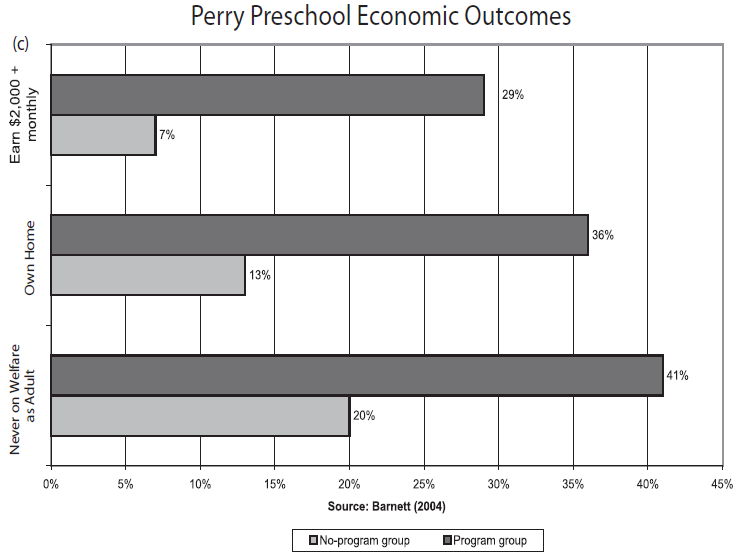
So if you are just looking at school test scores, the impact of these types of interventions can be debatable. However the authors of this recent research are able to examine more long run effects by linking data on STAR participants (now adults, it was conducted in the 1980s), to tax records. Their conclusions appear to be (the link above is to a presentation, I look forward to reading the full paper) that the contemporaneous rise in test scores is a good measure of the effect of the treatment on adult outcomes. According to their analysis, class size and teacher quality have an important impact on adult earnings. Again, this mirrors the findings from the Perry Preschool programme (shown below), where despite the same "fade out" in test scores, a significant positive effect was found on adult outcomes.
Friday, November 13, 2009
Early intervention reduces teenage pregnancy
"Ten controlled trials and five qualitative studies were included. Controlled trials evaluated either early childhood interventions or youth development programmes. The overall pooled effect size showed that teenage pregnancy rates were 39% lower among individuals receiving an intervention than in those receiving standard practice or no intervention (relative risk 0.61; 95% confidence interval 0.48 to 0.77)." from Harden et al. in the BMJ
Tuesday, November 10, 2009
Randomised Evaluation of a Parenting Programme
Donal O'Neill presented at the economics seminar on Friday. He has a new working paper on an early childhood intervention in Ireland.
A Cost-Benefit Analysis of Early Childhood Intervention: Evidence from a Randomised Evaluation of a Parenting Programme
by Donal O'Neill (October 2009)
Abstract:
A number of researchers and policy makers have recently argued that the most effective way of dealing with long-run disadvantage and the intergenerational transmission of poverty is through early childhood intervention and in particular policies aimed at supporting the family in early childhood development. In this paper we carry out a randomised evaluation of one such programme aimed at improving the skills and parenting strategies of parents, particularly those who find their child's behaviour difficult or challenging. Our evaluation shows that the treatment significantly reduced behavioural problems in young children when measured 6 months after the intervention. Furthermore our detailed cost analysis, combined with a consideration of the potential long-run benefits associated with the programme, suggest that the long-run rate of return to society from this programme is likely to be relatively high.
A Cost-Benefit Analysis of Early Childhood Intervention: Evidence from a Randomised Evaluation of a Parenting Programme
by Donal O'Neill (October 2009)
Abstract:
A number of researchers and policy makers have recently argued that the most effective way of dealing with long-run disadvantage and the intergenerational transmission of poverty is through early childhood intervention and in particular policies aimed at supporting the family in early childhood development. In this paper we carry out a randomised evaluation of one such programme aimed at improving the skills and parenting strategies of parents, particularly those who find their child's behaviour difficult or challenging. Our evaluation shows that the treatment significantly reduced behavioural problems in young children when measured 6 months after the intervention. Furthermore our detailed cost analysis, combined with a consideration of the potential long-run benefits associated with the programme, suggest that the long-run rate of return to society from this programme is likely to be relatively high.
Tuesday, October 27, 2009
No Einstein in Your Crib? Get a Refund
Several researchers in Geary are working on early influences on cognitive ability. Jim Heckman's work is well known in this area. This, from the NY Times, is interesting in that regard:
Parent alert: the Walt Disney Company is now offering refunds for all those “Baby Einstein” videos that did not make children into geniuses. They may have been a great electronic baby sitter, but the unusual refunds appear to be a tacit admission that they did not increase infant intellect. “We see it as an acknowledgment by the leading baby video company that baby videos are not educational, and we hope other baby media companies will follow suit by offering refunds,” said Susan Linn, director of Campaign for a Commercial-Free Childhood, which has been pushing the issue for years. Baby Einstein, founded in 1997, was one of the earliest players in what became a huge electronic media market for babies and toddlers. The videos — simple productions featuring music, puppets, bright colors, and not many words — became a staple of baby life: According to a 2003 study, a third of all American babies from 6 months to 2 years old had at least one “Baby Einstein” video.
Tamar Lewin, NY Times
Parent alert: the Walt Disney Company is now offering refunds for all those “Baby Einstein” videos that did not make children into geniuses. They may have been a great electronic baby sitter, but the unusual refunds appear to be a tacit admission that they did not increase infant intellect. “We see it as an acknowledgment by the leading baby video company that baby videos are not educational, and we hope other baby media companies will follow suit by offering refunds,” said Susan Linn, director of Campaign for a Commercial-Free Childhood, which has been pushing the issue for years. Baby Einstein, founded in 1997, was one of the earliest players in what became a huge electronic media market for babies and toddlers. The videos — simple productions featuring music, puppets, bright colors, and not many words — became a staple of baby life: According to a 2003 study, a third of all American babies from 6 months to 2 years old had at least one “Baby Einstein” video.
Tamar Lewin, NY Times
Sunday, September 06, 2009
Inter generational effects
| By: | Coneus, Katja Sprietsma, Maresa |
http://d.repec.org/n?u=RePEc:zbw:zewdip:09031&r=edu
Thursday, August 20, 2009
Vox Article on funding Early Childhood Services
Elizabeth Cascio
Proponents of universal early education hope that such investments will yield long-term socioeconomic benefits. This column presents evidence that state governments funding public kindergartens in the US actually widened socioeconomic disparities across adults, as whites made gains that blacks did not. That result highlights the sensitivity of policy interventions to their means of funding and the structure of existing alternatives.
http://www.VoxEU.org/index.php?q=node/3885
Proponents of universal early education hope that such investments will yield long-term socioeconomic benefits. This column presents evidence that state governments funding public kindergartens in the US actually widened socioeconomic disparities across adults, as whites made gains that blacks did not. That result highlights the sensitivity of policy interventions to their means of funding and the structure of existing alternatives.
http://www.VoxEU.org/index.php?q=node/3885
Subscribe to:
Posts (Atom)