Given that some of our regular readers and contributors are currently taking courses in London, i thought id take some time to remind them of the Economics sights and sounds.
Please feel free to add if you can think of anything economics related that our group could do while not studying!
Departments Listed in Top 20% RepEC.
Centre for Economic Policy Research (CEPR),
London School of Economics (LSE), University of London,
Institute for Fiscal Studies (IFS)
Centre for Economic Performance (CEP), London School of Economics (LSE), University of London,
Department of Economics, University College London, University of London, London
Economics Department, London School of Economics (LSE), University of London, London
Suntory and Toyota International Centres for Economics and Related Disciplines (STICERD), London School of Economics (LSE), University of London, London
Department of Economics, Royal Holloway, University of London, Egham
Economics, Finance and Management, University of Bristol, Bristol
Financial Markets Group (FMG), London School of Economics (LSE), University of London,
London Business School (LBS), University of London, London
Department of Economics, Birkbeck College, University of London, London
Bank of England, London
Department of Economics, London Business School (LBS), University of London, London
Department of Economics, Queen Mary, University of London, London
Tanaka School of Business, Imperial College, University of London, London
Jevons Institute for Competition Law and Economics, University College London, University of London, London
National Institute of Economic and Social Research (NIESR), London
Cass Business School, City University,, London
Department of Management, London School of Economics (LSE), University of London, London
Department of Economics, City University, London
Some Famous Economists With Links to London
http://en.wikipedia.org/wiki/John_Maynard_Keynes
http://en.wikipedia.org/wiki/Friedrich_von_Hayek
http://en.wikipedia.org/wiki/Jeremy_Bentham
http://en.wikipedia.org/wiki/David_Ricardo
See the article below on the IFS website for a good overview of London's role in the history of economics
http://www.ifs.org.uk/famous_economists/index.php
Thursday, July 31, 2008

Wednesday, July 30, 2008
Princeton Population Data Archive
Some extremely useful resources here for people working on fertility, migration, demography etc.,
http://opr.princeton.edu/archive/
Tuesday, July 29, 2008
NBER Working Paper: Air Pollution and Infant Health
Janet Currie, Matthew J. Neidell, Johannes Schmieder
NBER Working Paper No. 14196
Issued in July 2008NBER Program(s):
---- Abstract -----
We examine the impact of three "criteria" air pollutants on infant health in New Jersey in the 1990s by combining information about mother's residential location from birth certificates with information from air quality monitors. In addition to large sample size, our work offers three important innovations: First, because we know the exact addresses of mothers, we select those mothers closest to air monitors to ensure a more accurate measure of air quality. Second, since we follow mothers over time, we control for unobserved characteristics of mothers using maternal fixed effects. Third, we examine interactions of air pollution with smoking and other predictors of poor infant health outcomes. We find consistently negative effects of exposure to pollution, especially carbon monoxide, both during and after birth. The effects are considerably larger for smokers than for nonsmokers as well as for older mothers. Since automobiles are the main source of carbon monoxide emissions, our results have important implications for regulation of automobile emissions.
This paper is available as PDF (1290 K) or via email.
NBER Working Paper No. 14196
Issued in July 2008NBER Program(s):
---- Abstract -----
We examine the impact of three "criteria" air pollutants on infant health in New Jersey in the 1990s by combining information about mother's residential location from birth certificates with information from air quality monitors. In addition to large sample size, our work offers three important innovations: First, because we know the exact addresses of mothers, we select those mothers closest to air monitors to ensure a more accurate measure of air quality. Second, since we follow mothers over time, we control for unobserved characteristics of mothers using maternal fixed effects. Third, we examine interactions of air pollution with smoking and other predictors of poor infant health outcomes. We find consistently negative effects of exposure to pollution, especially carbon monoxide, both during and after birth. The effects are considerably larger for smokers than for nonsmokers as well as for older mothers. Since automobiles are the main source of carbon monoxide emissions, our results have important implications for regulation of automobile emissions.
This paper is available as PDF (1290 K) or via email.
Tags
Any suggestions for an efficient tagging system for the blog? Economics posts could be tagged by JEL Categories but that seems a little cumbersome.
The article below on Tagging might jog some ideas
http://en.wikipedia.org/wiki/Tag_%28metadata%29
The article below on Tagging might jog some ideas
http://en.wikipedia.org/wiki/Tag_%28metadata%29
Monday, July 28, 2008
Watching alone- Relational goods, television and happiness
This paper investigates the role of relational goods for subjective well-being.
Data from the World Values Survey is used to show that relational goods have a significant effect on life satisfaction, while television viewing plays a key role in crowding-out relationality.
The findings suggest that the relational treadmill can provide an additional explanation of the income–happiness paradox: the effect of higher income on happiness is offset by lower consumption of relational goods, with television playing a significant role in explaining underconsumption of relationality.
Bruni & Stanca (2008)

Day reconstruction method data would be amenable to such an analysis and may provide insight into the impact of social interaction/empathetic relations on well-being.
I think that work stress and cognitively demanding tasks may play a role in inducing post-work social withdrawal particularly amongst men. This wind-down strategy, typically assoicated with "vegging out" has been found to be effective in reducing circulating stress hormones but may be detrimental to well-being.
This is an incredibly popular way to pass weekday evenings typically coupled with fastfood, chinese take-aways, wine or beer, after a day of sedentary office work. It's no wonder some of us may start to look like this tubby tuber except perhaps without the smile!
Data from the World Values Survey is used to show that relational goods have a significant effect on life satisfaction, while television viewing plays a key role in crowding-out relationality.
The findings suggest that the relational treadmill can provide an additional explanation of the income–happiness paradox: the effect of higher income on happiness is offset by lower consumption of relational goods, with television playing a significant role in explaining underconsumption of relationality.
Bruni & Stanca (2008)

Day reconstruction method data would be amenable to such an analysis and may provide insight into the impact of social interaction/empathetic relations on well-being.
I think that work stress and cognitively demanding tasks may play a role in inducing post-work social withdrawal particularly amongst men. This wind-down strategy, typically assoicated with "vegging out" has been found to be effective in reducing circulating stress hormones but may be detrimental to well-being.
This is an incredibly popular way to pass weekday evenings typically coupled with fastfood, chinese take-aways, wine or beer, after a day of sedentary office work. It's no wonder some of us may start to look like this tubby tuber except perhaps without the smile!
Sunday, July 27, 2008
Study Economics - Make Money
I saw on Greg Mankiw's blog a forbes link that says Economics degrees are the second best in terms of earnings just behind engineering degrees.
The most lucrative college majors
What would happen if you took someone from Art History and forced them to study Economics? Would they still earn more? Ok, standard econometrics point but people do select themselves in to degrees on the basis of things like how much they want to make money, so raw earnings rankings dont seem sensible even though they have become more prevalant as a ranking measure particularly for Business and MBA type degrees. Could be viewed, i suppose, as a measure of the earnings quality of the network you are buying in to.
The most lucrative college majors
What would happen if you took someone from Art History and forced them to study Economics? Would they still earn more? Ok, standard econometrics point but people do select themselves in to degrees on the basis of things like how much they want to make money, so raw earnings rankings dont seem sensible even though they have become more prevalant as a ranking measure particularly for Business and MBA type degrees. Could be viewed, i suppose, as a measure of the earnings quality of the network you are buying in to.
Wordle
Tried out wordle - here is what the blog looks like as a wordle picture - ill post up anything else i can find - the text to mind map tool that stephen was looking at is very nice - the usual disclaimer about me having no knowledge of any of these things applies
http://www.text2mindmap.com/

http://www.text2mindmap.com/
Symposium
Thanks to everyone who presented at the Symposium. This was a really great day and showcased the huge amount of research going on here across all of our projects. I wont pick a best speaker but best quote certainly goes to Eibhlin who pointed out, during an explanation of the concept of vignette response equivalence, that to say your boyfriend is "fine" in Leitrim is a lot better than saying he is "excellent".
A booklet and book of abstracts will be circulating soon and ill post something up here. Look forward to doing this again.
A booklet and book of abstracts will be circulating soon and ill post something up here. Look forward to doing this again.
The role of work in psychological health and well-being
The primary theme of this article, which serves as the introductory contribution of a special section of the American Psychologist, is that work plays a central role in the development, expression, and maintenance of psychological health.
"Considerable research in vocational and industrial/organisational psychology has demonstrated that working can promote connection to the broader social and economic world, enhance well-being, and provide a means for individual satisfaction and accomplishment."
Three illustrative lines of inquiry in which research has affected the potential for informing public policy are presented: role of work in recovery from mental illness; occupational health psychology; and working, racism, and psychological health.
Blustein (2008)
"Considerable research in vocational and industrial/organisational psychology has demonstrated that working can promote connection to the broader social and economic world, enhance well-being, and provide a means for individual satisfaction and accomplishment."
Three illustrative lines of inquiry in which research has affected the potential for informing public policy are presented: role of work in recovery from mental illness; occupational health psychology; and working, racism, and psychological health.
Blustein (2008)
Saturday, July 26, 2008
Econ PhD Seminar
Looks like a very interesting session.
Weds July 30:
Brona Ni Chobhtaigh – History/Health – Explaining Trends in Irish Historical Infant Mortality
Wasiu Are – Public/Inequality – Analysis of changes in household income distribution in Ireland, 1994-2000: a semiparametric approach
Weds Aug 6th
Prudence Kwenda – Development – Poverty and Inequality
Michael Breen - International Political Economy - Delegation, Agency and IMF Conditionality
Weds Aug 13th
Fergal McCann – Trade/IO – Outsourcing and Firm Productivity
Fearghal O'hAodha – Behaviour/Consumption – Comparison of the Wealth Effect in UK and Germany
Weds Aug 20th
Christian Danne – Macro/Development - "Opportunity Windows, Commitment Devices, and Institution Building in Small Open Economies"
Gulnihal Aksoy – Macro. – Devaluation and Correlated Variables.
Weds Aug 27th
Eibhlin Hudson – Health – Child Health Inequalities
Martin Ryan – Education/Behaviour – An Essay in Education Economics.
Weds Sept 3
Dave Comerford – Behaviour- Reframing fixed costs as variable costs - an experiment to reduce car use
Peter Carney – Health. Special Surprise
Weds July 30:
Brona Ni Chobhtaigh – History/Health – Explaining Trends in Irish Historical Infant Mortality
Wasiu Are – Public/Inequality – Analysis of changes in household income distribution in Ireland, 1994-2000: a semiparametric approach
Weds Aug 6th
Prudence Kwenda – Development – Poverty and Inequality
Michael Breen - International Political Economy - Delegation, Agency and IMF Conditionality
Weds Aug 13th
Fergal McCann – Trade/IO – Outsourcing and Firm Productivity
Fearghal O'hAodha – Behaviour/Consumption – Comparison of the Wealth Effect in UK and Germany
Weds Aug 20th
Christian Danne – Macro/Development - "Opportunity Windows, Commitment Devices, and Institution Building in Small Open Economies"
Gulnihal Aksoy – Macro. – Devaluation and Correlated Variables.
Weds Aug 27th
Eibhlin Hudson – Health – Child Health Inequalities
Martin Ryan – Education/Behaviour – An Essay in Education Economics.
Weds Sept 3
Dave Comerford – Behaviour- Reframing fixed costs as variable costs - an experiment to reduce car use
Peter Carney – Health. Special Surprise
Warriors against rational choice
its been a while since a news story arrived in my email that motivated me to use the above heading but this one certainly does get you thinking about how you would represent these womens' indifference curves
http://news.bbc.co.uk/2/hi/in_depth/7527058.stm
"A plane was forced to make an emergency landing in Germany after two British women tried to open a cabin door mid-flight, police have said."
http://news.bbc.co.uk/2/hi/in_depth/7527058.stm
"A plane was forced to make an emergency landing in Germany after two British women tried to open a cabin door mid-flight, police have said."
Friday, July 25, 2008
Some More Problems with Ranking Student Satisfaction
A university in the UK has been expelled from the ranking system due its staff encouraging students to fill in the survey positively (or else they would be discriminated against in the job market). Ranking universities based on student satisfaction is really not having a good time lately in the validity stakes.
http://news.bbc.co.uk/2/hi/uk_news/education/7526061.stm
http://news.bbc.co.uk/2/hi/uk_news/education/7526061.stm
Competitiveness and Well-Being
Gerard O'Neill points on his blog to a NCC report on competitiveness and well-being
http://www.competitiveness.ie/ncc/reports/ncc080723/Wellbeing_Competitiveness.pdf
The report flags the issue of well-being in the context of competitiveness. A few random points that i would raise in the analysis of well-being measures are as follows
- newer measures such as Day Reconstruction should be considered. These give detailed accounts of daily well-being and allow for the analysis of environmental and technological factors influencing well-being
- We need to start defining better the concept of well-being. What are the main reference groups that people use in Ireland? Do we compare ourselves to our neighborhood, our town, our county, nationally, to America, to our past? How are we now judging our well-being? What standards are we applying?
- Related to the above, it should not be assumed that people interpret well-being and life satisfaction questions the same way across groups. We need to know more about what these questions mean to different groups of people
-Also, to what extent are reports of well-being stable as opposed to being influenced by focusing peoples attention on negative aspects of their situation and the world? For example, if you focus people on how they are falling behind relative to some reference group (e.g. men's circumstances getting better at a slower rate than females) does this cause distress compared to focusing them on improvement (e.g. men now have higher living standards factually measured than at any point in human history).
- in relation to competitiveness, how does framing of economic competitiveness affect stress levels? Much of the current framing is practically telling people that if they dont engage in dehumanising grinding work they will become obsolete rather than simply framing continuous training as just a normal part of life.
- how will the transformation of Ireland's economy in areas such as biotechnology, ICT, pharma etc., effect well-being. Will people enjoy the new employment that this transformation will create?
- we need to understand why well-being measures in Ireland have remained relatively static over the last number of years and yet suicide rates increased hugely over the economic boom period. I am currently working on trying to explain this.
- we need to know more about regional factors and their impact on well-being. The wide variation in conditions at town level and how towns have progressed in the last fifteen years is absent from current knowledge about well-being in Ireland. Some papers have been released recently on spatial factors that affect well-being including work by the School of Geography in UCD.
- What are the most distressing aspects of government policy and law? Bruno Frey and Alois Stutzer have written on distress caused by unfair treatment. It would be an interesting exercise to examine the extent to which institutions engagement with individuals can cause distress through perceived unfairness. In the context of competitiveness, the psychological impact of rapid sectoral change should be analysed. What are the main psychologically distressing features associated with job transitions? How could these be smoothed over?
- Also, the simple idea that greater competitiveness brings greater happiness through higher output should not be dismissed but its clearly not a full account. What cases exist where there is a trade-off between well-being and competitiveness? For example, carers do not provide "competitiveness" in the form of GDP increments but provide invaluable support to people who need them. We need to understand further how to conceptualise these trade-offs. The same applies for volunteerism and other aspects of the public and civic sphere.
- we definitley need more work on job satisfaction in Ireland. What jobs are dehumanising people? Could these aspects be changed? Both formal jobs and informal work such as caring should be looked at?
- we need more solid accounts of how well-being measures could influence policy. Kahneman and colleagues talk about national well-being accounts (see below). How would such accounts actually operate in a parliamentary context. Will, for example, there exist a situation where opposition parties berate the government for Ireland's happiness scores decreasing by 2 per cent since last year? Not likely but there is certainly a lot of information in these measures and we need to work out ways of communicating them that sound sensible in this cultural context.
http://ideas.repec.org/a/aea/aecrev/v94y2004i2p429-434.html
http://www.competitiveness.ie/ncc/reports/ncc080723/Wellbeing_Competitiveness.pdf
The report flags the issue of well-being in the context of competitiveness. A few random points that i would raise in the analysis of well-being measures are as follows
- newer measures such as Day Reconstruction should be considered. These give detailed accounts of daily well-being and allow for the analysis of environmental and technological factors influencing well-being
- We need to start defining better the concept of well-being. What are the main reference groups that people use in Ireland? Do we compare ourselves to our neighborhood, our town, our county, nationally, to America, to our past? How are we now judging our well-being? What standards are we applying?
- Related to the above, it should not be assumed that people interpret well-being and life satisfaction questions the same way across groups. We need to know more about what these questions mean to different groups of people
-Also, to what extent are reports of well-being stable as opposed to being influenced by focusing peoples attention on negative aspects of their situation and the world? For example, if you focus people on how they are falling behind relative to some reference group (e.g. men's circumstances getting better at a slower rate than females) does this cause distress compared to focusing them on improvement (e.g. men now have higher living standards factually measured than at any point in human history).
- in relation to competitiveness, how does framing of economic competitiveness affect stress levels? Much of the current framing is practically telling people that if they dont engage in dehumanising grinding work they will become obsolete rather than simply framing continuous training as just a normal part of life.
- how will the transformation of Ireland's economy in areas such as biotechnology, ICT, pharma etc., effect well-being. Will people enjoy the new employment that this transformation will create?
- we need to understand why well-being measures in Ireland have remained relatively static over the last number of years and yet suicide rates increased hugely over the economic boom period. I am currently working on trying to explain this.
- we need to know more about regional factors and their impact on well-being. The wide variation in conditions at town level and how towns have progressed in the last fifteen years is absent from current knowledge about well-being in Ireland. Some papers have been released recently on spatial factors that affect well-being including work by the School of Geography in UCD.
- What are the most distressing aspects of government policy and law? Bruno Frey and Alois Stutzer have written on distress caused by unfair treatment. It would be an interesting exercise to examine the extent to which institutions engagement with individuals can cause distress through perceived unfairness. In the context of competitiveness, the psychological impact of rapid sectoral change should be analysed. What are the main psychologically distressing features associated with job transitions? How could these be smoothed over?
- Also, the simple idea that greater competitiveness brings greater happiness through higher output should not be dismissed but its clearly not a full account. What cases exist where there is a trade-off between well-being and competitiveness? For example, carers do not provide "competitiveness" in the form of GDP increments but provide invaluable support to people who need them. We need to understand further how to conceptualise these trade-offs. The same applies for volunteerism and other aspects of the public and civic sphere.
- we definitley need more work on job satisfaction in Ireland. What jobs are dehumanising people? Could these aspects be changed? Both formal jobs and informal work such as caring should be looked at?
- we need more solid accounts of how well-being measures could influence policy. Kahneman and colleagues talk about national well-being accounts (see below). How would such accounts actually operate in a parliamentary context. Will, for example, there exist a situation where opposition parties berate the government for Ireland's happiness scores decreasing by 2 per cent since last year? Not likely but there is certainly a lot of information in these measures and we need to work out ways of communicating them that sound sensible in this cultural context.
http://ideas.repec.org/a/aea/aecrev/v94y2004i2p429-434.html
Student Attendance
Stephen Kinsella has some interesting thoughts on his blog about student attendance. Below are the references from the paper he cites which include some interesting stuff and i add another one- we will be doing research here on this over the next couple of years.
Barrett, R., Rainer, A. and Marczyk, O. (2007) “Managed Learning Environments and an Attendance Crisis?“, The Electronic Journal of e-Learning, 5(1), pp. 1-10
Burd, E. and Hodgson, B. (2006) “Attendance and Attainment: A Five Year Study“, Innovation in Teaching And Learning in Information and Computer Sciences, 5(2)
Clay, T. and Breslow, L. (2006) “Why Students Don’t Attend Class“, MIT Faculty Newsletter, XVIII(4)
Clearly-Holdforth, J. (2007) “Student non-attendance in higher education. A phenomenon of student apathy or poor pedagogy?“, DIT Level 3, 5
http://www2.warwick.ac.uk/fac/soc/economics/research/papers/twerp_820.pdf
One view of low attendance (aside from the usual versions which cite either bad students, bad lecturers or both) is that there is insufficient differentiation between offerings at higher level. Purely anecdotallly from my own experience as a lecturer, there is a cohort of students who would happily never set foot on a college campus for anything other than a two-week cramming session if they could avoid it. Many of these students simply cant or wont take the financial hit from not working in paid employment and would never consider borrowing to finance their degree. Another group really want to buy in to their college and practically live in it for the four years. Both groups would benefit from more differentiation of offerings and if the university system is flexible enough we should see options developing that would suit school leavers who want to work while building up credits and other options developing that would suit students who are desperate to make the grade to the elite world graduate schools and therefore want to accelerate their module options by taking enhanced hours on campus, as well as moves to develop the whole college experience for students including internships etc.,
Modularisation will resolve some of this as students can stagger their degree more and, in many cases, embed evening courses and so on. If attendances are declining at traditional lecture formats, more flexibility of this nature seems a likely route. As someone who took a distance masters in philosophy (still completing some) while i was working on a very hectic job, I was extremely grateful for the flexibility of the format and it mellowed me out from thinking that such courses lowered the standards in higher education. They simply provide more choice and we should think more about these as options where students are clearly signalling that they do not want the traditional format. The market will then decide how much they value the qualifications.
Barrett, R., Rainer, A. and Marczyk, O. (2007) “Managed Learning Environments and an Attendance Crisis?“, The Electronic Journal of e-Learning, 5(1), pp. 1-10
Burd, E. and Hodgson, B. (2006) “Attendance and Attainment: A Five Year Study“, Innovation in Teaching And Learning in Information and Computer Sciences, 5(2)
Clay, T. and Breslow, L. (2006) “Why Students Don’t Attend Class“, MIT Faculty Newsletter, XVIII(4)
Clearly-Holdforth, J. (2007) “Student non-attendance in higher education. A phenomenon of student apathy or poor pedagogy?“, DIT Level 3, 5
http://www2.warwick.ac.uk/fac/soc/economics/research/papers/twerp_820.pdf
One view of low attendance (aside from the usual versions which cite either bad students, bad lecturers or both) is that there is insufficient differentiation between offerings at higher level. Purely anecdotallly from my own experience as a lecturer, there is a cohort of students who would happily never set foot on a college campus for anything other than a two-week cramming session if they could avoid it. Many of these students simply cant or wont take the financial hit from not working in paid employment and would never consider borrowing to finance their degree. Another group really want to buy in to their college and practically live in it for the four years. Both groups would benefit from more differentiation of offerings and if the university system is flexible enough we should see options developing that would suit school leavers who want to work while building up credits and other options developing that would suit students who are desperate to make the grade to the elite world graduate schools and therefore want to accelerate their module options by taking enhanced hours on campus, as well as moves to develop the whole college experience for students including internships etc.,
Modularisation will resolve some of this as students can stagger their degree more and, in many cases, embed evening courses and so on. If attendances are declining at traditional lecture formats, more flexibility of this nature seems a likely route. As someone who took a distance masters in philosophy (still completing some) while i was working on a very hectic job, I was extremely grateful for the flexibility of the format and it mellowed me out from thinking that such courses lowered the standards in higher education. They simply provide more choice and we should think more about these as options where students are clearly signalling that they do not want the traditional format. The market will then decide how much they value the qualifications.
Thursday, July 24, 2008
The Impact of Child Health on Labour Market Outcomes
Paper from Tuesday's seminar available below
Abstract
This paper examines impacts of childhood health on SES outcomes observed during adulthood- levels and trajectories of education, family income, household wealth, individual earnings and labor supply. The analysis is conducted using data that collects these SES measures in a panel who were originally children and who are now well into their adult years. Since all siblings are in the panel, one can control for unmeasured family and neighborhood background effects. With the exception of education, poor childhood health has a quantitatively large effect on all these outcomes. Moreover, these estimated effects are larger when unobserved family effects are controlled.
http://ideas.repec.org/e/psm28.html
Abstract
This paper examines impacts of childhood health on SES outcomes observed during adulthood- levels and trajectories of education, family income, household wealth, individual earnings and labor supply. The analysis is conducted using data that collects these SES measures in a panel who were originally children and who are now well into their adult years. Since all siblings are in the panel, one can control for unmeasured family and neighborhood background effects. With the exception of education, poor childhood health has a quantitatively large effect on all these outcomes. Moreover, these estimated effects are larger when unobserved family effects are controlled.
http://ideas.repec.org/e/psm28.html
Chief Happiness Officer
The blog of the Chief Happiness Officer is quite a good resource for those interested in how economic psychology applies to labour markets and the workplace. Most of Alexander Kjerulf's (the Chief Officer's) work is about creating happiness in the workplace. Here's a light-hearted cartoon from a recent post by Kjerulf on the old idea of the ratrace.
Tuesday, July 22, 2008
Centre Symposium Tomorrow
This event takes place in the seminar room in Geary Institute tomorrow (23rd) from 9.15 to 6pm.
http://geary.ucd.ie/index.php/Events-Items/Geary-Institute-One-Day-Symposium-on-Health-and-Behaviour.html
http://geary.ucd.ie/index.php/Events-Items/Geary-Institute-One-Day-Symposium-on-Health-and-Behaviour.html
Sunday, July 20, 2008
How your behaviour affects your children's DNA
An article on epi-genetics from the Sunday Times
http://www.timesonline.co.uk/tol/life_and_style/health/article4364054.ece
http://www.timesonline.co.uk/tol/life_and_style/health/article4364054.ece
Visualising Text
Does anyone know of a simple way to visualise lots of comments taken from people in a open-ended survey questions and visualise them like a tag-cloud? - i know there are sophisticated packages for conducting thematic analyses using this type of data but Im looking for something very simple for the purpose of a presentation.
In general, what can be usefully done with this type of data - for example i have 12,000 or so open-ended replies about the most important issues in higher education as derived from the students in a big survey. Im not thinking of submitting this to Econometrica but i am interested in the results and some simple ways to present them with a view to guiding survey design.
In general, what can be usefully done with this type of data - for example i have 12,000 or so open-ended replies about the most important issues in higher education as derived from the students in a big survey. Im not thinking of submitting this to Econometrica but i am interested in the results and some simple ways to present them with a view to guiding survey design.
Econometrics Videos
Some useful econometrics videos below
http://www.economicsnetwork.ac.uk/subjects/econometrics.htm
Also, would reiterate that the NBER Summer Institute videos are the best online econometric resource that I know of.
http://www.economicsnetwork.ac.uk/teaching/nber_videos.htm
I would also strongly recommend that people working on microeconometric topics try out the Cameron and Trivedi textbook linked below. Extremely well-written book with a great website that gives data-sets, solutions and do-files. Alan Krueger writes in his review that "I wish this was available when I was a student".
http://cameron.econ.ucdavis.edu/mmabook/mma.html
http://www.economicsnetwork.ac.uk/subjects/econometrics.htm
Also, would reiterate that the NBER Summer Institute videos are the best online econometric resource that I know of.
http://www.economicsnetwork.ac.uk/teaching/nber_videos.htm
I would also strongly recommend that people working on microeconometric topics try out the Cameron and Trivedi textbook linked below. Extremely well-written book with a great website that gives data-sets, solutions and do-files. Alan Krueger writes in his review that "I wish this was available when I was a student".
http://cameron.econ.ucdavis.edu/mmabook/mma.html
Saturday, July 19, 2008
Behavioural Economics and Guardian Readers
"Impressive that the Tories garbage problem has been psychologically sorted, but how would George Osborne now propose to nudge us out of a recession?"
The way behavioural economics and Nudge, in particular, is being received in the UK is fascinating to see unfold - we havent had the debate in Ireland and we should - the modern literature looks like it could be implemented to make tax and savings systems more effective, to improve outcomes for students, to reduce incentives distortions in government welfare programmes etc., But, as of yet, it hasn't even featured at all in any of the central debates (not even so much as an angry rant about it being too quantitative!)
http://www.guardian.co.uk/politics/2008/jul/18/conservatives.economics
The British debate is focusing a lot on a number of criticisms of the implementation of behavioural economics ideas including (1) the perceived preponderence of small student samples in the behavioural literature (2) the fact that the ideas are from the USA and all ideas from the USA must, according to some of the commentators, be viewed as flawed (3) that implementing these ideas means removing a community focus from policy (4) that these ideas are a distraction from current problems around inflation and a contracting economy (5) that the ideas place most focus on the consumer rather than examining issues like poor governance, corporate fraud and so on (6) that many of the commentators perceive behavioural economics interventions to be a form of trickery.
People should read the Thaler and Benartzi (2004) paper in the JPE on "Save More Tomorrow" and a few of the others below to make up their mind (access might be restricted by journals but other copies online).
http://ideas.repec.org/a/ucp/jpolec/v112y2004is1ps164-s187.html (save more tomorrow)
http://ideas.repec.org/a/aea/aecrev/v94y2004i2p419-423.html (paper on behavioural economics)
http://ideas.repec.org/p/cla/levrem/122247000000000966.html (paper on the effects of quick enrolment)
The way behavioural economics and Nudge, in particular, is being received in the UK is fascinating to see unfold - we havent had the debate in Ireland and we should - the modern literature looks like it could be implemented to make tax and savings systems more effective, to improve outcomes for students, to reduce incentives distortions in government welfare programmes etc., But, as of yet, it hasn't even featured at all in any of the central debates (not even so much as an angry rant about it being too quantitative!)
http://www.guardian.co.uk/politics/2008/jul/18/conservatives.economics
The British debate is focusing a lot on a number of criticisms of the implementation of behavioural economics ideas including (1) the perceived preponderence of small student samples in the behavioural literature (2) the fact that the ideas are from the USA and all ideas from the USA must, according to some of the commentators, be viewed as flawed (3) that implementing these ideas means removing a community focus from policy (4) that these ideas are a distraction from current problems around inflation and a contracting economy (5) that the ideas place most focus on the consumer rather than examining issues like poor governance, corporate fraud and so on (6) that many of the commentators perceive behavioural economics interventions to be a form of trickery.
People should read the Thaler and Benartzi (2004) paper in the JPE on "Save More Tomorrow" and a few of the others below to make up their mind (access might be restricted by journals but other copies online).
http://ideas.repec.org/a/ucp/jpolec/v112y2004is1ps164-s187.html (save more tomorrow)
http://ideas.repec.org/a/aea/aecrev/v94y2004i2p419-423.html (paper on behavioural economics)
http://ideas.repec.org/p/cla/levrem/122247000000000966.html (paper on the effects of quick enrolment)
Public health video
For a public health video on obesity see "Brave Heart (Mutiny in the Cardiovascular System)"
http://www.youtube.com/watch?v=gI6KhUrKpN0
http://www.youtube.com/watch?v=gI6KhUrKpN0
Friday, July 18, 2008
RWJF Alerts - Food Marketing to Kids
From the RWJF Alerts
A study in the July issue of the British journal Obesity Reviews finds that 89 percent of the foods marketed to children are of poor nutritional quality, Reuters reports. Canadian researchers applied the Center for Science in the Public Interest's (CSPI) nutritional standards for healthy food to 367 products packaged for children—items that promoted fun and play, came in packages with cartoon images or were linked to children's television programs, films or other merchandise. The CSPI standards require that healthy foods contain no more than 35 percent added sugar by weight; derive no more than 35 percent of their calories from fat; and contain no more than 230 milligrams of sodium per serving for snack foods and 770 milligrams of sodium per serving for prepared meals. Of the products studied, 70 percent had higher-than-recommended levels of sugar, 23 percent had too much fat and 17 percent exceeded the sodium thresholds. But because researchers were unable to differentiate between added sugars and naturally occurring sugars such as those from milk and fruit, the number of products categorized as having too much sugar and too little nutritional quality may have been higher than it would have been using more sophisticated methodology. The researchers also studied the products’ nutritional assertions and found positive claims on the packaging of 62 percent of items not meeting the CSPI standards. The study's lead author, Charlene Elliott, notes that some promotions can mislead parents: "If a parent sees a product that makes specific nutritional claims, they may assume that the whole product is nutritious, and our study has shown that that is definitely not true in the vast majority of cases." The authors recommend that policy-makers focus on the packaging used for foods targeting children and make efforts to verify the nutritional statements made by products ( Reuters, 7/14/08; Obesity Reviews release, 7/15/08; Elliot, Obesity Reviews, July 2008 [registration required]). Editor’s note: The Center for Science in the Public Interest is a past recipient of several grants from the Robert Wood Johnson Foundation.
A study in the July issue of the British journal Obesity Reviews finds that 89 percent of the foods marketed to children are of poor nutritional quality, Reuters reports. Canadian researchers applied the Center for Science in the Public Interest's (CSPI) nutritional standards for healthy food to 367 products packaged for children—items that promoted fun and play, came in packages with cartoon images or were linked to children's television programs, films or other merchandise. The CSPI standards require that healthy foods contain no more than 35 percent added sugar by weight; derive no more than 35 percent of their calories from fat; and contain no more than 230 milligrams of sodium per serving for snack foods and 770 milligrams of sodium per serving for prepared meals. Of the products studied, 70 percent had higher-than-recommended levels of sugar, 23 percent had too much fat and 17 percent exceeded the sodium thresholds. But because researchers were unable to differentiate between added sugars and naturally occurring sugars such as those from milk and fruit, the number of products categorized as having too much sugar and too little nutritional quality may have been higher than it would have been using more sophisticated methodology. The researchers also studied the products’ nutritional assertions and found positive claims on the packaging of 62 percent of items not meeting the CSPI standards. The study's lead author, Charlene Elliott, notes that some promotions can mislead parents: "If a parent sees a product that makes specific nutritional claims, they may assume that the whole product is nutritious, and our study has shown that that is definitely not true in the vast majority of cases." The authors recommend that policy-makers focus on the packaging used for foods targeting children and make efforts to verify the nutritional statements made by products ( Reuters, 7/14/08; Obesity Reviews release, 7/15/08; Elliot, Obesity Reviews, July 2008 [registration required]). Editor’s note: The Center for Science in the Public Interest is a past recipient of several grants from the Robert Wood Johnson Foundation.
Bloggingheads TV
Five foundations or morality are discussed: Harm/Care, Fairness/Reciprocity, Ingroup loyalty, Authority/Respect and Purity/Sanctity.
Thursday, July 17, 2008
Seminar Geary Institute
Professor James P Smith of the RAND Corporation and Visiting Professor at UCD will present Tuesday 22nd July 2008 at 1pm in the Geary Institute Seminar Room on childhood health inequalities. Coffee and Sandwiches provided
Self Control and Consumerism - Vatican Edition
"Our world has grown weary of greed, exploitation and division, of the tedium of false idols and piecemeal responses, and the pain of false promises,"
http://news.bbc.co.uk/2/hi/asia-pacific/7510862.stm
http://news.bbc.co.uk/2/hi/asia-pacific/7510862.stm
Wednesday, July 16, 2008
DCU Researchers Report
A report by the research staff association in DCU is linked below. It outlines a viewpoint on the difficulties of being on research staff as opposed to traditional academic staff -
http://www.ducra.dcu.ie/documents/buildingRearcherCareers.pdf
the huge recent literature on returns to PhD, PhD matching, skill biased technological change are all interesting with regard to thinking about issues involved. Ireland is working on doubling the number of PhD's in Irish universities and substantially increasing the number of researchers working in the universities. Most of the people who read this blog are part of this in one way or another.
http://www.ducra.dcu.ie/documents/buildingRearcherCareers.pdf
the huge recent literature on returns to PhD, PhD matching, skill biased technological change are all interesting with regard to thinking about issues involved. Ireland is working on doubling the number of PhD's in Irish universities and substantially increasing the number of researchers working in the universities. Most of the people who read this blog are part of this in one way or another.
Again from NBER Working Papers - Ideas and Economic Growth
http://www.nber.org/papers/w14133
Robert Lucas
---- Abstract -----
What is it about modern capitalist economies that allows them, in contrast to all earlier societies, to generate sustained growth in productivity and living standards? It is widely agreed that the productivity growth of the industrialized economies is mainly an ongoing intellectual achievement, a sustained flow of new ideas. Are these ideas the achievements of a few geniuses, Newton, Beethoven, and a handful of others, viewed as external to the activities of ordinary people? Are they the product of a specialized research sector, engaged in the invention of patent-protected processes over which they have monopoly rights? Both images are based on important features of reality and both have inspired interesting growth theories, but neither seems to me central. What is central, I believe, is that fact that the industrial revolution involved the emergence (or rapid expansion) of a class of educated people, thousands–now many millions–of people who spend entire careers exchanging ideas, solving work-related problems, generating new knowledge.
From NBER - Financial Literacy: An Essential Tool for Informed Consumer Choice?
http://www.nber.org/papers/w14084
---- Abstract -----
Increasingly, individuals are in charge of their own financial security and are confronted with ever more complex financial instruments. However, there is evidence that many individuals are not well-equipped to make sound saving decisions. This paper demonstrates widespread financial illiteracy among the U.S. population, particularly among specific demographic groups. Those with low education, women, African-Americans, and Hispanics display particularly low levels of literacy. Financial literacy impacts financial decision-making. Failure to plan for retirement, lack of participation in the stock market, and poor borrowing behavior can all be linked to ignorance of basic financial concepts. While financial education programs can result in improved saving behavior and financial decision-making, much can be done to improve these programs' effectiveness.
IAREP Programme
The Economic Psychology conference programme is now available - very exciting stuff!
http://www.luiss.it/iarep2008/programme/programme1.php
http://www.luiss.it/iarep2008/programme/programme1.php
Vengeance from the NBER
Naci H. Mocan
NBER Working Paper No. 14131Issued in July 2008
http://www.nber.org/papers/w14131
---- Abstract -----
This paper investigates the extent of vengeful feelings and their determinants using data on more than 89,000 individuals from 53 countries. Country characteristics (such as per-capita income, average education of the country, presence of an armed conflict, the extent of the rule-of-law, uninterrupted democracy, individualism) as well as personal attributes of the individuals influence vengeful feelings. The magnitude of vengeful feelings is greater for people in low-income countries, in countries with low levels of education, low levels of the rule-of-law, in collectivist countries and in countries that experienced an armed conflict in recent history. Females, older people, working people, people who live in high-crime areas of their country and people who are at the bottom 50% of their country's income distribution are more vengeful. The intensity of vengeful feelings dies off gradually over time. The findings suggest that vengeful feelings of people are subdued as a country develops economically and becomes more stable politically and socially and that both country characteristics and personal attributes are important determinants of vengeance. Poor people who live in higher-income societies that are ethno-linguistically homogeneous are as vengeful as rich people who live in low-income societies that are ethno-linguistically fragmented. These results reinforce the idea that some puzzles about individual choice can best be explained by considering the interplay of personal and cultural factors.
NBER Working Paper No. 14131Issued in July 2008
http://www.nber.org/papers/w14131
---- Abstract -----
This paper investigates the extent of vengeful feelings and their determinants using data on more than 89,000 individuals from 53 countries. Country characteristics (such as per-capita income, average education of the country, presence of an armed conflict, the extent of the rule-of-law, uninterrupted democracy, individualism) as well as personal attributes of the individuals influence vengeful feelings. The magnitude of vengeful feelings is greater for people in low-income countries, in countries with low levels of education, low levels of the rule-of-law, in collectivist countries and in countries that experienced an armed conflict in recent history. Females, older people, working people, people who live in high-crime areas of their country and people who are at the bottom 50% of their country's income distribution are more vengeful. The intensity of vengeful feelings dies off gradually over time. The findings suggest that vengeful feelings of people are subdued as a country develops economically and becomes more stable politically and socially and that both country characteristics and personal attributes are important determinants of vengeance. Poor people who live in higher-income societies that are ethno-linguistically homogeneous are as vengeful as rich people who live in low-income societies that are ethno-linguistically fragmented. These results reinforce the idea that some puzzles about individual choice can best be explained by considering the interplay of personal and cultural factors.
Tuesday, July 15, 2008
Student Loan Schemes Around the World
IZA DP No. 3588 - Hua Shen, Adrian Ziderman:
"Student Loans Repayment and Recovery: International Comparisons"
http://ftp.iza.org/dp3588.pdf
"Student Loans Repayment and Recovery: International Comparisons"
"Student loans schemes are in operation in more than seventy countries around the world. Most loans schemes benefit from sizeable built-in government subsidies and, in addition, are subject to repayment default and administrative costs that are not passed on to student borrowers. We probe two issues in this paper, for 44 loans schemes in 39 countries: how much of the original loan is an individual student required to repay (the "repayment ratio") and what percentage of the total costs of loans schemes can the lending body expect to receive back in repayments (the "recovery ratio")? The analysis shows considerable variation in the size of the repayment and recovery ratios across schemes. Moreover, many loans schemes exhibit sizeable built-in subsidies accruing to student borrowers – in over 40 percent of the schemes examined, the repayment ratio is 40 percent or less. Overall loans recovery is considerably lower."
http://ftp.iza.org/dp3588.pdf
Plato's Republic - Classic Book Club
Thanks to Martin for moderating the session on Aristotle's Politics. If anyone is interested, we are looking at Plato's Republic on Monday August 4th at 7pm (ill post up location in advance)
A copy of the book is below:
http://classics.mit.edu/Plato/republic.html
Some upcoming ones include:
Friedman and Schwartz - Monetary History of the US
Locke - Two Treatises on Government
Schumpeter - History of Economic Analysis
Suggestions welcome
A copy of the book is below:
http://classics.mit.edu/Plato/republic.html
Some upcoming ones include:
Friedman and Schwartz - Monetary History of the US
Locke - Two Treatises on Government
Schumpeter - History of Economic Analysis
Suggestions welcome
Sunday, July 13, 2008
Job satisfaction among US Ph.D. graduates
(Philippe Moguérou, European Commission, 2003)
In this paper we try to understand the determinants of job satisfaction. The population of US Ph.D. graduates provides a useful homogeneity - same level of education - and an interesting heterogeneity - different career outcomes, academics vs. non academics. Empirically we use the Survey of Doctorate Recipients carried out by the NSF. We estimate models on a sample of 30,000 Ph.D.s in science and engineering. Contrary to all the previous studies we find that females express themselves as less satisfied with their jobs than males. More generally, we find that job satisfaction is explained by different sets of variables respectively for males and females, and for academics and non-academics.
The Graduate Junction
The Social Science Statistics Blog mentions this social networking site (The Graduate Junction), which is intended to help graduate students share research ideas. As SSSB says, "I'm not sure where it falls in the spectrum from Facebook to Wikipedia, but perhaps it will be useful."
Saturday, July 12, 2008
Capital Ideas
The University of Chicago Graduate Business School publish a really useful magazine called Capital Ideas. Worth signing up to. Current issue features work by Thaler and Cialdini among others (in fact it features Cialdini and colleague's work on the prompts not to use all the towels in the hotel room - telling people truthfully that most people adhere to the norm seems to have the biggest effect)
http://www.chicagogsb.edu/capideas/may08/4.aspx
http://www.chicagogsb.edu/capideas/may08/4.aspx
Critical Review of Nudge in The Sunday Times
Bryan Appleyard offers a polemical take on the Nudge idea in last weeks Sunday Times. His review raises some interesting issues but doesnt get at why people are so interested in the book - namely that the ideas behind it are lifting a big barrier in terms of collaboration between economics, psychology, policy and law and generating a lot of policy ideas.
"But there is one big issue. These choice architects are going to be extremely powerful people under the Obamist-Cameroon dispensation. It looks as though we are all going to be manipulated all the time."
"However, much the government nudges people to eat better, the advertisers will always be out there telling them to fatten themselves to death. I am writing this in America, and I can tell you it's working."
http://entertainment.timesonline.co.uk/tol/arts_and_entertainment/books/non-fiction/article4268165.ece
From the perspective of Irish policy, there are dozens of topics that reading the book will offer some insights on including: waiting lists for organs, retirement savings systems, education choice support systems, self-assessed taxation, sub-prime borrowing and lending, student finance, addiction, welfare spending etc., One of the main contributions of the book is that it finally kills any notion that the literatures in social psychology, cognitive psychology etc., are not relevant to these problems and helps to resolve a bizarre situation where people were designing tax, student finance and pension systems among others without thinking about the cognitive skills of normal human beings.
It is difficult to see how, after the debates around this book, it will be possible to frame an incentive system without considering ideas from psychologists, economists, lawyers etc., In that sense, the book and associated literature (e.g. the Thaler and Benartzi 2004 paper) are having an enormous and positive influence on public policy debates. As the columnist pessimistly predicts, its hard to imagine that somebody somewhere is not going to find a really stupid way of applying these ideas but we cant blame the authors for that!
One issue that is being raised is how Nudge and associated economics literature adds to literatures such as social marketing, consumer psychology, ergonomics, compliance and the general behavioural intervention literature in addiction. For example, the book references the psychology literature on the success of the reminders to people that the environment gets damaged from overuse of washing machines and detergents in reducing towel use in hotels. It also references behavioural intervention work across psychology.
All of this literature is based, more or less, on the assumption that individuals do not make fully rational decisions in many circumstances unless guided by another individual or helped by well-framed choices and i dont personally know anyone working in psychology who would have ever doubted that. Many of the people i know who are psychologists cant fully grasp why the ideas in Nudge are considered new (with perhaps the exception of the idea of Libertarian Paternalism as a political alternative). It would be very interesting to see someone from the literature in consumer psychology, compliance or behavioural interventions or ergonomics write a well reasoned account of how the new wave of behavioural economics fits in with these literatures and whether the insights from behavioural economics are a substantial advance. If Nudge was revised, Chapter 17 entitled "Objections" should address the main criticism that i have heard voiced which is that essentially Nudge is old wine in new bottles, a repackaging of well-established literatures rather than a fundamentally new way of thinking.
"But there is one big issue. These choice architects are going to be extremely powerful people under the Obamist-Cameroon dispensation. It looks as though we are all going to be manipulated all the time."
"However, much the government nudges people to eat better, the advertisers will always be out there telling them to fatten themselves to death. I am writing this in America, and I can tell you it's working."
http://entertainment.timesonline.co.uk/tol/arts_and_entertainment/books/non-fiction/article4268165.ece
From the perspective of Irish policy, there are dozens of topics that reading the book will offer some insights on including: waiting lists for organs, retirement savings systems, education choice support systems, self-assessed taxation, sub-prime borrowing and lending, student finance, addiction, welfare spending etc., One of the main contributions of the book is that it finally kills any notion that the literatures in social psychology, cognitive psychology etc., are not relevant to these problems and helps to resolve a bizarre situation where people were designing tax, student finance and pension systems among others without thinking about the cognitive skills of normal human beings.
It is difficult to see how, after the debates around this book, it will be possible to frame an incentive system without considering ideas from psychologists, economists, lawyers etc., In that sense, the book and associated literature (e.g. the Thaler and Benartzi 2004 paper) are having an enormous and positive influence on public policy debates. As the columnist pessimistly predicts, its hard to imagine that somebody somewhere is not going to find a really stupid way of applying these ideas but we cant blame the authors for that!
One issue that is being raised is how Nudge and associated economics literature adds to literatures such as social marketing, consumer psychology, ergonomics, compliance and the general behavioural intervention literature in addiction. For example, the book references the psychology literature on the success of the reminders to people that the environment gets damaged from overuse of washing machines and detergents in reducing towel use in hotels. It also references behavioural intervention work across psychology.
All of this literature is based, more or less, on the assumption that individuals do not make fully rational decisions in many circumstances unless guided by another individual or helped by well-framed choices and i dont personally know anyone working in psychology who would have ever doubted that. Many of the people i know who are psychologists cant fully grasp why the ideas in Nudge are considered new (with perhaps the exception of the idea of Libertarian Paternalism as a political alternative). It would be very interesting to see someone from the literature in consumer psychology, compliance or behavioural interventions or ergonomics write a well reasoned account of how the new wave of behavioural economics fits in with these literatures and whether the insights from behavioural economics are a substantial advance. If Nudge was revised, Chapter 17 entitled "Objections" should address the main criticism that i have heard voiced which is that essentially Nudge is old wine in new bottles, a repackaging of well-established literatures rather than a fundamentally new way of thinking.
TRIL
Worth looking at the page of the project below for some idea of where a lot of ageing research is focused in Ireland
"The TRIL Centre is a coordinated collection of research projects addressing the physical, cognitive and social consequences of ageing, all informed by ethnographic research and supported by a shared pool of knowledge and engineering resources.
The TRIL Centre’s mission is to discover and deliver technology solutions which support independent ageing, ideally in a home environment. This will improve the quality of life of older citizens while reducing the burden on carers and on the healthcare system. The Project is a collaborative effort combining Intel personnel and researchers from Irish universities and hospitals in multi-disciplinary teams."
http://www.trilcentre.org/
"The TRIL Centre is a coordinated collection of research projects addressing the physical, cognitive and social consequences of ageing, all informed by ethnographic research and supported by a shared pool of knowledge and engineering resources.
The TRIL Centre’s mission is to discover and deliver technology solutions which support independent ageing, ideally in a home environment. This will improve the quality of life of older citizens while reducing the burden on carers and on the healthcare system. The Project is a collaborative effort combining Intel personnel and researchers from Irish universities and hospitals in multi-disciplinary teams."
http://www.trilcentre.org/
What does behavioural economics mean for policy?
A paper from Kooreman and Prast
http://www.netspar.nl/events/2007/april/panel/paperpp2.pdf
Abstract:
New insights from behavioral economics have profound implications for policymakers. A
key finding in behavioral economics is that people often do not behave in their best interest even if they know what their best interest is. Another insight is that people are extremely sensitive to the way choices are presented to them. These effects are particularly pronounced in the areas of
financial planning and health-related behavior. This provides scope for a new type of policy interventions: libertarian, or soft, paternalism. Soft paternalism helps individuals to make choices that are in their best interest. It does not eliminate choice options, and is an inexpensive type of policy. This paper discusses the behavioral policy options in the fields of personal savings and health, with an emphasis on Dutch institutions. We recommend a much more effective use of soft paternalism, in particular by setting smart defaults and by using unorthodox commitment mechanisms.
http://www.netspar.nl/events/2007/april/panel/paperpp2.pdf
Abstract:
New insights from behavioral economics have profound implications for policymakers. A
key finding in behavioral economics is that people often do not behave in their best interest even if they know what their best interest is. Another insight is that people are extremely sensitive to the way choices are presented to them. These effects are particularly pronounced in the areas of
financial planning and health-related behavior. This provides scope for a new type of policy interventions: libertarian, or soft, paternalism. Soft paternalism helps individuals to make choices that are in their best interest. It does not eliminate choice options, and is an inexpensive type of policy. This paper discusses the behavioral policy options in the fields of personal savings and health, with an emphasis on Dutch institutions. We recommend a much more effective use of soft paternalism, in particular by setting smart defaults and by using unorthodox commitment mechanisms.
Time to end love affair with car?
A BBC article about weaning the US off the use of cars as the main form of transport.
http://news.bbc.co.uk/2/hi/americas/7486705.stm
Dublin is about to get its own version of the Paris Velib project and i know at least one person who reads this blog who believes the future is nudge-driven bipedalism and cyclophilia.
http://www.independent.ie/business/media/hitech-panels-finally-on-way-1430486.html
Another view of the future is given by the BBC below
http://news.bbc.co.uk/2/hi/uk_news/politics/4652534.stm
http://news.bbc.co.uk/2/hi/americas/7486705.stm
Dublin is about to get its own version of the Paris Velib project and i know at least one person who reads this blog who believes the future is nudge-driven bipedalism and cyclophilia.
http://www.independent.ie/business/media/hitech-panels-finally-on-way-1430486.html
Another view of the future is given by the BBC below
http://news.bbc.co.uk/2/hi/uk_news/politics/4652534.stm
Friday, July 11, 2008
Microsoft Live Labs
Its worth keeping an eye on these to think of interesting social science research applications
http://labs.live.com/CategoryView.aspx?category=nav_Projects
Not entirely sure of its social science research use but the TED talk on Photosynth is still very worth watching
http://www.ted.com/index.php/talks/blaise_aguera_y_arcas_demos_photosynth.html
http://labs.live.com/CategoryView.aspx?category=nav_Projects
Not entirely sure of its social science research use but the TED talk on Photosynth is still very worth watching
http://www.ted.com/index.php/talks/blaise_aguera_y_arcas_demos_photosynth.html
"It’s the drink" was one theory
In their paper "Well-Being, Insecurity and the Decline of American Job Satisfaction", Blancflower and Oswald report that well-being is higher among Ireland than in any other ´advanced nation.´ Furthermore, Ireland and Sweden are the least-stressed countries in the European Union. Thanks is given in the acknowledgements to numerous Irish journalists who proposed that ‘it’s the drink’ was one theory.
Thursday, July 10, 2008
GIS Maps from 2006 Census Data
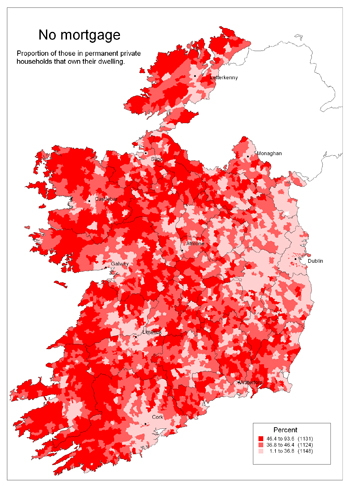
The UCD School of Geography, Planning and Environmental Policy have produced a series of maps, as part of a mapping project (and book) based on 2006 Census data from Ireland. The map below shows how the team have visualised the geographical distribution of mortgage-free homes in Ireland. Other GIS maps produced in the series include:
* Ratio of single females to single males
* Households with no motor car
* Households with two or more motor cars
* Use of public transport
* Daily time spent travelling
* Early risers
* Voluntary activity
* Early school leavers
Read more about the project here on the UCD news website.

* Ratio of single females to single males
* Households with no motor car
* Households with two or more motor cars
* Use of public transport
* Daily time spent travelling
* Early risers
* Voluntary activity
* Early school leavers
Read more about the project here on the UCD news website.
healthcare-economist.com
healthcare-economist.com is a lively blog that features a lot of health-economics related material. Other recent posts on the blog provide good summaries of the new Heckman paper on "Econometric Causality", and the Beshears et al paper on "Barriers to Revealed Preference".
Wednesday, July 09, 2008
Pitfalls of student satisfaction approach
The student satisfaction approach is taking a beating in a lot of recent papers including the one below from the Economics of Education Review which suggests it may be at the root of a decline in standards in higher education. Clearly, much of the subjective satisfaction of students will depend on what they expect and their knowledge of the discipline and both of these can be diminished by bad teaching which then confounds the relationship between satisfaction and performance.
Using standard satisfaction metrics on their own as performance metrics in comparative exercises just doesnt seem tenable anymore given the recent literature. An approach that focuses on an agreed set of competencies that students should have picked up or an agreed set of outcomes is an alternative. Many universities and courses point to the success of their alumni as evidence of the quality of their courses but this is equally problematic due to selection.
Abstract
http://ideas.repec.org/a/eee/ecoedu/v27y2008i4p417-428.html
"Using data on 4 years of courses at American University, regression results show that actual grades have a significant, positive effect on student evaluations of teaching (SETs), controlling for expected grade and fixed effects for both faculty and courses, and for possible endogeneity. Implications are that the SET is a faulty measure of teaching quality and grades a faulty signal of future job performance. Students, faculty, and provost appear to be engaged in an individually rational but socially destructive game of grade inflation centered on the link between SETs and grades. When performance is hard to measure, pay-for-performance, embodied by the link between SETs and faculty pay, may have unintended adverse consequences."
Using standard satisfaction metrics on their own as performance metrics in comparative exercises just doesnt seem tenable anymore given the recent literature. An approach that focuses on an agreed set of competencies that students should have picked up or an agreed set of outcomes is an alternative. Many universities and courses point to the success of their alumni as evidence of the quality of their courses but this is equally problematic due to selection.
Abstract
http://ideas.repec.org/a/eee/ecoedu/v27y2008i4p417-428.html
"Using data on 4 years of courses at American University, regression results show that actual grades have a significant, positive effect on student evaluations of teaching (SETs), controlling for expected grade and fixed effects for both faculty and courses, and for possible endogeneity. Implications are that the SET is a faulty measure of teaching quality and grades a faulty signal of future job performance. Students, faculty, and provost appear to be engaged in an individually rational but socially destructive game of grade inflation centered on the link between SETs and grades. When performance is hard to measure, pay-for-performance, embodied by the link between SETs and faculty pay, may have unintended adverse consequences."
CEMMAP Courses
These courses are extremely useful for PhD students and other researchers in microeconometrics
2008 events include:
- TRAINING COURSE: Introductory Microeconometrics
15 - 17 October 2008, UCL (London)
http://cemmap.ifs.org.uk/courses.php?event_id=358
- TRAINING COURSE: Panel / Longitudinal Data Analysis
06 - 07 November 2008, UCL (London)
http://cemmap.ifs.org.uk/courses.php?event_id=359
- WORKSHOP: Unobserved Factor Models
20 - 21 November 2008, London
Speakers include: Jushan Bai (NYU), Christian Gourieroux (University of Toronto, ENSAE) and Lucrezia Reichlin (London Business School) http://cemmap.ifs.org.uk/conferences.php?event_id=370
- TRAINING COURSE: Policy Evaluation Methods
03 - 05 December, UCL (London)
http://cemmap.ifs.org.uk/courses.php?event_id=360
2008 events include:
- TRAINING COURSE: Introductory Microeconometrics
15 - 17 October 2008, UCL (London)
http://cemmap.ifs.org.uk/courses.php?event_id=358
- TRAINING COURSE: Panel / Longitudinal Data Analysis
06 - 07 November 2008, UCL (London)
http://cemmap.ifs.org.uk/courses.php?event_id=359
- WORKSHOP: Unobserved Factor Models
20 - 21 November 2008, London
Speakers include: Jushan Bai (NYU), Christian Gourieroux (University of Toronto, ENSAE) and Lucrezia Reichlin (London Business School) http://cemmap.ifs.org.uk/conferences.php?event_id=370
- TRAINING COURSE: Policy Evaluation Methods
03 - 05 December, UCL (London)
http://cemmap.ifs.org.uk/courses.php?event_id=360
It´s a Kind of Matching
Labour market mismatch has traditionally been thought of in the context of unemployment, as opposed to a skills mismatch after educational attainment. According to Soininen´s PhD thesis (2006), the ´matching function´ and the Beveridge curve are two extensively utilized relationships in labour economics.
In the contemporary literature, Budria and Moro-Egido (2004) "differentiate between three different types of educational mismatch: ‘over-qualification’, ‘incorrect qualification’, and ‘strong mismatch’." They find that while over-qualification and incorrect qualification are not associated with lower wages, strong mismatch carries a pay penalty that ranges from 13% to 27%. Strong (or skills) mismatch is a particular interest, particularly after attainment of PhD qualifications.
But given the mention of the Beveridge Curve above, here is an interesting discussion about the relationship between vacancies and unemployment in the contemporary British economy.
The Beveridge curve describes the negative, convex to origo relationship between vacancies and unemployed, which is the outcome of the matching function. The name derives from William Beveridge, an English social politician, who discovered the relationship in the 1930s. Being far down on the Beveridge curve indicates that a low number of vacancies corresponds to high unemployment and being far up on the curve indicates that a high number of vacancies corresponds to low unemployment... The matching function was first mentioned at the end of the 1970s in the economics literature.
In the contemporary literature, Budria and Moro-Egido (2004) "differentiate between three different types of educational mismatch: ‘over-qualification’, ‘incorrect qualification’, and ‘strong mismatch’." They find that while over-qualification and incorrect qualification are not associated with lower wages, strong mismatch carries a pay penalty that ranges from 13% to 27%. Strong (or skills) mismatch is a particular interest, particularly after attainment of PhD qualifications.
But given the mention of the Beveridge Curve above, here is an interesting discussion about the relationship between vacancies and unemployment in the contemporary British economy.
The Science of Asking Questions
For those interested in the nuances of questionnaire design, this paper is a non-technical overview of some conisderations.
Survey methodologists have drawn on and contributed to research by cognitive psychologists, conversation analysts, and others to lay a foundation for the science of asking questions. Our discussion of this work is structured around the decisions that must be made for two common types of inquiries: questions about events or behaviors and questions that ask for evaluations or attitudes. The issues we review for behaviors include definitions, reference periods, response dimensions, and response categories. The issues we review for attitudes include bipolar versus unipolar scales, number of categories, category labels, don’t know filters, and acquiescence. We also review procedures for question testing and evaluation.
Modelling OCD
The idea of using neoclassical microeconomics to model OCD seems intriguing. This looks a really clever paper.
Obsessive–compulsive disorder and behavioral therapy: A rational-choice perspective
Gideon Yaniv Mathematical Social Sciences Volume 55, Issue 3, May 2008, Pages 405-415
Obsessive–compulsive disorder (OCD) is a mental syndrome characterized by intrusive thoughts that trigger some repetitive action the individual feels driven to perform in order to relieve the anxiety engendered by the disturbing thoughts. A natural measure for the severity of OCD is the duration of the repetitive ritual. This paper presents a dynamic model of rational OCD that determines the optimal number of compulsory repetitions over the individual's lifecycle through the choice of therapy intensity. The analysis reveals that in the case of mild disorder, compulsory repetitions rise steadily along the rationally optimal trajectory. In the case of severe disorder, the rationally optimal trajectory is U-shaped, with compulsory repetitions declining for some time before turning around and rising again. Recent studies suggest, however, that the majority of patients experience a waning and waxing course of illness. In particular, symptoms are often worse during times of psychological stress. Incorporating stress into the model, the paper shows that a waning and waxing course may be the outcome of rational coping with the emergence of stress.
Obsessive–compulsive disorder and behavioral therapy: A rational-choice perspective
Gideon Yaniv Mathematical Social Sciences Volume 55, Issue 3, May 2008, Pages 405-415
Obsessive–compulsive disorder (OCD) is a mental syndrome characterized by intrusive thoughts that trigger some repetitive action the individual feels driven to perform in order to relieve the anxiety engendered by the disturbing thoughts. A natural measure for the severity of OCD is the duration of the repetitive ritual. This paper presents a dynamic model of rational OCD that determines the optimal number of compulsory repetitions over the individual's lifecycle through the choice of therapy intensity. The analysis reveals that in the case of mild disorder, compulsory repetitions rise steadily along the rationally optimal trajectory. In the case of severe disorder, the rationally optimal trajectory is U-shaped, with compulsory repetitions declining for some time before turning around and rising again. Recent studies suggest, however, that the majority of patients experience a waning and waxing course of illness. In particular, symptoms are often worse during times of psychological stress. Incorporating stress into the model, the paper shows that a waning and waxing course may be the outcome of rational coping with the emergence of stress.
Tuesday, July 08, 2008
Xavier Gaibax - MIT Course on Economics and Psychology
This excellent MIT initiative has made lots of courses available online. This is the most relevant to the diehards that tune in to this weblog
http://ocw.mit.edu/OcwWeb/Economics/14-13Spring2004/CourseHome/index.htm
http://ocw.mit.edu/OcwWeb/Economics/14-13Spring2004/CourseHome/index.htm
NBER Working Paper - Do Professors Matter?
In this paper, in some subjects less experienced lecturers give better grades but prepare their students less adaquately thus leading them to do worse later on (or something similar to that!). Interesting.
In this paper the students are randomly assigned to instructors. If you are a student and only worried about grades, its difficult to know the optimal strategy if you had control over which lecturer (or in practice which field course) to pick given that you know at some stage you will have to do the hard courses. When there is selection, its even possible that all the students with high discount rates will select the lecturers they think are easiest so you get peer effects on top of that.
Scott E. Carrell, James E. West
NBER Working Paper No. 14081Issued in June 2008NBER Program(s):
---- Abstract -----
It is difficult to measure teaching quality at the postsecondary level because students typically "self-select" their coursework and their professors. Despite this, student evaluations of professors are widely used in faculty promotion and tenure decisions. We exploit the random assignment of college students to professors in a large body of required coursework to examine how professor quality affects student achievement. Introductory course professors significantly affect student achievement in contemporaneous and follow-on related courses, but the effects are quite heterogeneous across subjects. Students of professors who as a group perform well in the initial mathematics course perform significantly worse in follow-on related math, science, and engineering courses. We find that the academic rank, teaching experience, and terminal degree status of mathematics and science professors are negatively correlated with contemporaneous student achievement, but positively related to follow-on course achievement. Across all subjects, student evaluations of professors are positive predictors of contemporaneous course achievement, but are poor predictors of follow-on course achievement.
This paper is available as PDF (633 K) or via email.
Machine-readable bibliographic record - MARC, RIS, BibTeX
In this paper the students are randomly assigned to instructors. If you are a student and only worried about grades, its difficult to know the optimal strategy if you had control over which lecturer (or in practice which field course) to pick given that you know at some stage you will have to do the hard courses. When there is selection, its even possible that all the students with high discount rates will select the lecturers they think are easiest so you get peer effects on top of that.
Scott E. Carrell, James E. West
NBER Working Paper No. 14081Issued in June 2008NBER Program(s):
---- Abstract -----
It is difficult to measure teaching quality at the postsecondary level because students typically "self-select" their coursework and their professors. Despite this, student evaluations of professors are widely used in faculty promotion and tenure decisions. We exploit the random assignment of college students to professors in a large body of required coursework to examine how professor quality affects student achievement. Introductory course professors significantly affect student achievement in contemporaneous and follow-on related courses, but the effects are quite heterogeneous across subjects. Students of professors who as a group perform well in the initial mathematics course perform significantly worse in follow-on related math, science, and engineering courses. We find that the academic rank, teaching experience, and terminal degree status of mathematics and science professors are negatively correlated with contemporaneous student achievement, but positively related to follow-on course achievement. Across all subjects, student evaluations of professors are positive predictors of contemporaneous course achievement, but are poor predictors of follow-on course achievement.
This paper is available as PDF (633 K) or via email.
Machine-readable bibliographic record - MARC, RIS, BibTeX
Monday, July 07, 2008
Interdisciplinary Research: Case Studies from Health and Social Science
This newlyupdated and revised edition of Interdisciplinary Research is a substantive and practical guide to the most effective avenues for collaborative and integrative research in the social, behavioral, and bio-medical sciences. It provides answers to questions such as what is the best way to conductinterdisciplinary research on topics related to human health, behavior, and development? Which are the most successful interdisciplinary research programs in these areas? How do you identify appropriate collaborators? How do you find dedicated funding streams? How do you overcome peer-review and publishing challenges? This is the only book that provides answers directly from researchers who have carried out successful interdisciplinary programs. The editors give a concise of account of the lessons that can be taken from the book, and then present a series of case studies that reveal themost successful interdisciplinary research programs. These programs provide a variety of models of how best to undertake interdisciplinary research.
The book includes a chapter on 'Social Resources and Health' by Michael Marmot, a chapter on 'Affective Neuroscience' by Richard Davidson, a chapter on 'Multi-level analyses and social neuroscience' by Gary Berntson and John Cacioppo, and part five is dedicated to interdisciplinary research on the prevention and management of HIV/AIDS.
The book includes a chapter on 'Social Resources and Health' by Michael Marmot, a chapter on 'Affective Neuroscience' by Richard Davidson, a chapter on 'Multi-level analyses and social neuroscience' by Gary Berntson and John Cacioppo, and part five is dedicated to interdisciplinary research on the prevention and management of HIV/AIDS.
Distinctions between hedonic and eudaimonic well-being
Kopperud and colleagues present results from a day reconstruction study among Norwegian jobholders. The study suggests that hedonic and eudaimonic well-being can be studied by theoretical and empirical analysis of subjective feelings.
In this approach, pleasure is the hallmark of hedonism, and engagement serves as the core feeling of eudaimonia.
The research stream that I think most resembles eudaimonic well-being is in the area of 'human flourishing' which is thought to be a result of four key components: (a) goodness, indexed by happiness, satisfaction, and superior functioning; (b) generativity, indexed by broadened thought–action repertoires and behavioral flexibility; (c) growth, indexed by gains in enduring personal and social resources; and (d) resilience, indexed by survival and growth in the aftermath of adversity.
Another recent discussion of eudaimonic well-being defines this as "the essence of the two great
Greek imperatives: first, to ‘‘know thyself’’ (a phrase inscribed on the temple of Apollo at Delphi), and second, to ‘‘choose yourself’’ or ‘‘become what you are’’. " This article goes on to specify further the dimensions of psychological well-being as self-acceptance, purpose in life, autonomy, environmental mastery, positive relationships, and personal growth.
From this analysis it is clear that eudaimonic well-being goes far beyond engagement but also that this sense may be a rough approximation for environmental mastery, autonomy, generativity and so on.
In the study discussed the Day Reconstruction Method was used to investigate the assumption that overall life satisfaction predicts hedonic feelings but not eudaimonic feelings during a workday. Perceived job control was hypothesized to predict eudaimonic feelings but not hedonic feelings. Questionnaire data from 120 Norwegian jobholders were analyzed, providing support for the hypothesis. Moreover, pleasure was found to be relatively unrelated to engagement, and perceived control was basically unrelated to life satisfaction. The results are discussed against the background that hedonism and eudaimonia are two independent parts of a multidimensional concept of well-being.
Kopperud et al (2008)
In this approach, pleasure is the hallmark of hedonism, and engagement serves as the core feeling of eudaimonia.
The research stream that I think most resembles eudaimonic well-being is in the area of 'human flourishing' which is thought to be a result of four key components: (a) goodness, indexed by happiness, satisfaction, and superior functioning; (b) generativity, indexed by broadened thought–action repertoires and behavioral flexibility; (c) growth, indexed by gains in enduring personal and social resources; and (d) resilience, indexed by survival and growth in the aftermath of adversity.
Another recent discussion of eudaimonic well-being defines this as "the essence of the two great
Greek imperatives: first, to ‘‘know thyself’’ (a phrase inscribed on the temple of Apollo at Delphi), and second, to ‘‘choose yourself’’ or ‘‘become what you are’’. " This article goes on to specify further the dimensions of psychological well-being as self-acceptance, purpose in life, autonomy, environmental mastery, positive relationships, and personal growth.
From this analysis it is clear that eudaimonic well-being goes far beyond engagement but also that this sense may be a rough approximation for environmental mastery, autonomy, generativity and so on.
In the study discussed the Day Reconstruction Method was used to investigate the assumption that overall life satisfaction predicts hedonic feelings but not eudaimonic feelings during a workday. Perceived job control was hypothesized to predict eudaimonic feelings but not hedonic feelings. Questionnaire data from 120 Norwegian jobholders were analyzed, providing support for the hypothesis. Moreover, pleasure was found to be relatively unrelated to engagement, and perceived control was basically unrelated to life satisfaction. The results are discussed against the background that hedonism and eudaimonia are two independent parts of a multidimensional concept of well-being.
Kopperud et al (2008)
Is well-being U-shaped over the life cycle?
Blanchflower & Oswald (2008) present evidence that psychological well-being is U-shaped through life. Using data on 500,000 randomly sampled Americans and West Europeans, the paper designs a test that can control for cohort effects. Holding other factors constant happiness reaches its minimum middle age. The U-shape in age is found in separate well-being regression equations in 72 developed and developing nations. The authors also note that American male birth-cohorts seem to have become progressively less content with their lives.
Sunday, July 06, 2008
Culture of Honour
In the brilliant 'Culture of Honor: The psychology of violence in the south' Richard Nisbett and Dov Cohen integrate historical, survey, social policy, and experimental data to support an argument which sourced the cultural transmission of the greater violent response to insult in the southern states vs the northern states centrally to the economic value of sustaining ones reputation if one is a herder vs a crop farmer.
In a recent PNAS article the foundations of this argument are supported:
Ecocultural basis of cognition: Farmers and fishermen are more holistic than herders
It has been proposed that social interdependence fosters holistic cognition, that is, a tendency to attend to the broad perceptual and cognitive field, rather than to a focal object and its properties, and a tendency to reason in terms of relationships and similarities, rather than rules and categories. This hypothesis has been supported mostly by demonstrations showing that East Asians, who are relatively interdependent, reason and perceive in a more holistic fashion than do Westerners. We examined holistic cognitive tendencies in attention, categorization, and reasoning in three types of communities that belong to the same national, geographic, ethnic, and linguistic regions and yet vary in their degree of social interdependence: farming, fishing, and herding communities in Turkey's eastern Black Sea region. As predicted, members of farming and fishing communities, which emphasize harmonious social interdependence, exhibited greater holistic tendencies than members of herding communities, which emphasize individual decision making and foster social independence. Our findings have implications for how ecocultural factors may have lasting consequences on important aspects of cognition.
Ayse K. Uskul, Shinobu Kitayama, and Richard E. Nisbett (2008)
In a recent PNAS article the foundations of this argument are supported:
Ecocultural basis of cognition: Farmers and fishermen are more holistic than herders
It has been proposed that social interdependence fosters holistic cognition, that is, a tendency to attend to the broad perceptual and cognitive field, rather than to a focal object and its properties, and a tendency to reason in terms of relationships and similarities, rather than rules and categories. This hypothesis has been supported mostly by demonstrations showing that East Asians, who are relatively interdependent, reason and perceive in a more holistic fashion than do Westerners. We examined holistic cognitive tendencies in attention, categorization, and reasoning in three types of communities that belong to the same national, geographic, ethnic, and linguistic regions and yet vary in their degree of social interdependence: farming, fishing, and herding communities in Turkey's eastern Black Sea region. As predicted, members of farming and fishing communities, which emphasize harmonious social interdependence, exhibited greater holistic tendencies than members of herding communities, which emphasize individual decision making and foster social independence. Our findings have implications for how ecocultural factors may have lasting consequences on important aspects of cognition.
Ayse K. Uskul, Shinobu Kitayama, and Richard E. Nisbett (2008)
Saturday, July 05, 2008
Steven Levitt on Car-Seats
Levitt's TED talk on the effectiveness of child car-seats in reducing child road deaths is linked below. he discusses on his blog that the speech bombed but its well worth watching. a version of the paper is below though a later paper seems to show some effects on reducing injuries (as he previews in the talk)
http://www.ted.com/index.php/talks/steven_levitt_on_child_carseats.html
http://freakonomics.blogs.nytimes.com/2008/07/02/a-speech-of-mine-that-bombed/http://pricetheory.uchicago.edu/levitt/Papers/levitt_carseats_farsdata.pdf
http://www.aeaweb.org/annual_mtg_papers/2008/2008_119.pdf
ESRC National Centre for Research Methods
The Conference of the ESRC National Centre for Research Methods in Oxford took place during the week. The website of the Centre is below:
http://www.ncrm.ac.uk/
The programme for the conference is below and worth scanning, particularly if you are working on "mixed-methods" type work.
http://www.ncrm.ac.uk/RMF2008/festival/index.php
Some of their publications are below including one on mixed methods - for better or worse i can never see this approach having any impact in economics. Ive blogged before about a couple of researchers in economics who have used qualitative interviewing with decision makers to examine the plausability of various theories and there are also some people interested in philosophy of science issues in economics who take a somewhat qualitative stance. But, in general, the likelihood that methods such as semi-structured interviews, focus groups etc., would ever be accepted as solid evidence in mainstream economics journals seems low based on current evidence. Though techniques like verbal protocol analysis might become more common in empirical decision making studies.
http://www.ncrm.ac.uk/research/outputs/publications/
http://www.ncrm.ac.uk/research/outputs/publications/documents/MethodsReviewPaperNCRM-005.pdf
http://www.ncrm.ac.uk/
The programme for the conference is below and worth scanning, particularly if you are working on "mixed-methods" type work.
http://www.ncrm.ac.uk/RMF2008/festival/index.php
Some of their publications are below including one on mixed methods - for better or worse i can never see this approach having any impact in economics. Ive blogged before about a couple of researchers in economics who have used qualitative interviewing with decision makers to examine the plausability of various theories and there are also some people interested in philosophy of science issues in economics who take a somewhat qualitative stance. But, in general, the likelihood that methods such as semi-structured interviews, focus groups etc., would ever be accepted as solid evidence in mainstream economics journals seems low based on current evidence. Though techniques like verbal protocol analysis might become more common in empirical decision making studies.
http://www.ncrm.ac.uk/research/outputs/publications/
http://www.ncrm.ac.uk/research/outputs/publications/documents/MethodsReviewPaperNCRM-005.pdf
Friday, July 04, 2008
Considering the Future: The Conceptualization and Measurement of Elaboration on Potential Outcomes
Nenkov et al examine a new construct dealing with individuals' tendency to elaborate on potential outcomes, that is, to generate and evaluate potential positive and negative consequences of their behaviors.
The researchers develop the elaboration on potential outcomes (EPO) scale and then investigate its relationships with conceptually related traits and its association with consumer behaviors such as exercise of self-control, procrastination, compulsive buying, credit card debt, retirement investing, and healthy lifestyle.
Those with high EPO levels exhibit more effective self-regulation when faced with a choice and that EPO can be primed, temporarily improving self-regulation for those with low EPO levels.
Nenkov et al., Journal of Consumer Research, June 2008
The researchers develop the elaboration on potential outcomes (EPO) scale and then investigate its relationships with conceptually related traits and its association with consumer behaviors such as exercise of self-control, procrastination, compulsive buying, credit card debt, retirement investing, and healthy lifestyle.
Those with high EPO levels exhibit more effective self-regulation when faced with a choice and that EPO can be primed, temporarily improving self-regulation for those with low EPO levels.
Nenkov et al., Journal of Consumer Research, June 2008
Thursday, July 03, 2008
Preferences for College Courses in Ireland
Preferences for college courses have been discussed before on this blog. In one post on 'Matching Undergraduate Students to Their Interests', we asked "how closely are first year undergraduates matched to the course that they wanted to do when they filled out their CAO form?" A number of problems are possible:
- there is only partial information available until the student enters the college course of their choice
- students may choose “high points” courses simply because they are “high points” courses (and not true preferences); albeit a slightly different issue it is also worth reading another post that was on this blog before (see here) about priority matching schemes and the clearinghouse for university admissions in Germany
- another problem is exemplified by the applicant who decides to look only at courses within a certain points band. For example, let us say that a student anticipates getting 340 points. "He or she will scour the lists of last year's cut-off points, picking courses that "cost" 340 points or thereabouts, almost regardless of the content of the course" (see end of this Irish Independent article)
An article from Science mentioned on this blog before describes a potential solution to preference misalignmnet - at least in the specific subject domain of science. The article describes how some American universities have been trying to match science students to their interests: "Linking Student Interests to Science Curricula". A course called “The Chemistry and Biology of Everyday Life” (CBEL) was developed using students’ interests in everyday life as the starting point for instruction. Of course, the American higher education system is largely non-specialised at entry to under-graduate level (see a previous post about this here), which allows for initiatives such as CBEL to be more effective. So what is to be done in the Irish case?
One recent initiative was the announcement that from 2009 onwards, Leaving Certificate points will count for less with regard to how places on medicine courses are allocated. Under the new system, there is a points threshold (480) at which a candidate becomes eligible to sit an aptitude test. While a working party has reviewed international practice on the best aptitude test available, there is still some disadvantage in dispensing with a pure points-based market (or clearing-house) for college places.
The disadvantage is the lack of complete anonymity which the clearing-house system provides. The Central Applications Office (CAO) was was established in Ireland in 1976 to streamline and co-ordinate student applications for university places (Coolahan, 1991). The most salient feature of the CAO points system however, is that it discriminates among applicants on an anonymous basis. A voluntary code is sufficient to guarantee that the position of a particular course in an applicant’s order of preference has no bearing on assessment for admission to that course (CAO, 2006).
Of course, there is a trade-off between complete anonymity and the problems which accompany the clearing-house system. It has already been mentioned that students may choose “high points” courses simply because they are “high points” courses (and not true preferences). But there is also the need to grind out a high-points performance if one wants to do a high-demand course such as law or medicine. Much has been made of the "points race" in recent years and the grind-school phenomenon which de-values a rounded education and puts sole emphasis on the stressful pursuit of points-score maximisation. Read comments from the HEA here about the points race being far from over.
Last August, the Irish Independent published an analysis of Leaving Certificate points, prepared by its own statistician, over the years 1992 (when the current points scale was introduced) until 2007 (see story here). This showed that the numbers of candidates scoring 450 points or higher (that is, the total band of 450 to 600) rose from 6.2pc in 1992 to 18.3pc in 2007. Of course, there are many other issues that get raised in this debate such as whether Leaving Certificate courses are being dumbed down, or whether the number of places for medicine or law should be increased. One thing we do now is that while total net CAO acceptances increased from 26,762 in 1992 to 38,967 in 2006, the total number of courses on offer increased from 244 to 378 (see page 4 of this CAO Board of Directors' Report for 2006).
There is some good news in all of this for UCD at least. Figures for CAO applications show that UCD first preferences are up 5.2% on 2007. A total of 7,073 students gave UCD their first preference compared to 6,724 in 2007. In addition, this reflects a strong performance in Science – particularly omnibus entry where first preferences were up almost 30%. See story here.
- there is only partial information available until the student enters the college course of their choice
- students may choose “high points” courses simply because they are “high points” courses (and not true preferences); albeit a slightly different issue it is also worth reading another post that was on this blog before (see here) about priority matching schemes and the clearinghouse for university admissions in Germany
- another problem is exemplified by the applicant who decides to look only at courses within a certain points band. For example, let us say that a student anticipates getting 340 points. "He or she will scour the lists of last year's cut-off points, picking courses that "cost" 340 points or thereabouts, almost regardless of the content of the course" (see end of this Irish Independent article)
An article from Science mentioned on this blog before describes a potential solution to preference misalignmnet - at least in the specific subject domain of science. The article describes how some American universities have been trying to match science students to their interests: "Linking Student Interests to Science Curricula". A course called “The Chemistry and Biology of Everyday Life” (CBEL) was developed using students’ interests in everyday life as the starting point for instruction. Of course, the American higher education system is largely non-specialised at entry to under-graduate level (see a previous post about this here), which allows for initiatives such as CBEL to be more effective. So what is to be done in the Irish case?
One recent initiative was the announcement that from 2009 onwards, Leaving Certificate points will count for less with regard to how places on medicine courses are allocated. Under the new system, there is a points threshold (480) at which a candidate becomes eligible to sit an aptitude test. While a working party has reviewed international practice on the best aptitude test available, there is still some disadvantage in dispensing with a pure points-based market (or clearing-house) for college places.
The disadvantage is the lack of complete anonymity which the clearing-house system provides. The Central Applications Office (CAO) was was established in Ireland in 1976 to streamline and co-ordinate student applications for university places (Coolahan, 1991). The most salient feature of the CAO points system however, is that it discriminates among applicants on an anonymous basis. A voluntary code is sufficient to guarantee that the position of a particular course in an applicant’s order of preference has no bearing on assessment for admission to that course (CAO, 2006).
Of course, there is a trade-off between complete anonymity and the problems which accompany the clearing-house system. It has already been mentioned that students may choose “high points” courses simply because they are “high points” courses (and not true preferences). But there is also the need to grind out a high-points performance if one wants to do a high-demand course such as law or medicine. Much has been made of the "points race" in recent years and the grind-school phenomenon which de-values a rounded education and puts sole emphasis on the stressful pursuit of points-score maximisation. Read comments from the HEA here about the points race being far from over.
Last August, the Irish Independent published an analysis of Leaving Certificate points, prepared by its own statistician, over the years 1992 (when the current points scale was introduced) until 2007 (see story here). This showed that the numbers of candidates scoring 450 points or higher (that is, the total band of 450 to 600) rose from 6.2pc in 1992 to 18.3pc in 2007. Of course, there are many other issues that get raised in this debate such as whether Leaving Certificate courses are being dumbed down, or whether the number of places for medicine or law should be increased. One thing we do now is that while total net CAO acceptances increased from 26,762 in 1992 to 38,967 in 2006, the total number of courses on offer increased from 244 to 378 (see page 4 of this CAO Board of Directors' Report for 2006).
There is some good news in all of this for UCD at least. Figures for CAO applications show that UCD first preferences are up 5.2% on 2007. A total of 7,073 students gave UCD their first preference compared to 6,724 in 2007. In addition, this reflects a strong performance in Science – particularly omnibus entry where first preferences were up almost 30%. See story here.
The Genetics of Personality and Well-Being
Weiss et al. used a representative sample of 973 twin pairs to test the hypothesis that heritable
differences in subjective well-being are entirely accounted for by the genetic architecture of the Five-Factor Model’s personality domains. Results supported this model
The researchers conclude that "geneticists interested in subjective well-being should focus their search for genes on those genes that influence personality". Given that the FFM explains under 20% of the variance in subjective well-being in the normal population I'm not so sure about this.
Weiss et al. (2008)
differences in subjective well-being are entirely accounted for by the genetic architecture of the Five-Factor Model’s personality domains. Results supported this model
The researchers conclude that "geneticists interested in subjective well-being should focus their search for genes on those genes that influence personality". Given that the FFM explains under 20% of the variance in subjective well-being in the normal population I'm not so sure about this.
Weiss et al. (2008)
Sad and Self-Focused Individuals Spend More
In this months Psychological Science Cynthia Cryder (aptonym here?) and colleagues show that misery is not miserly: Infact sadness increases the amount of money that decision makers give up to acquire a commodity. The researchers also show that self-focus moderates the effect of sadness on spending.
Don't worry, the study used real commodities and money so the results may hold implications for everyday decisions.
Cryder, Lerner, Gross, & Dahl (2008)
Don't worry, the study used real commodities and money so the results may hold implications for everyday decisions.
Cryder, Lerner, Gross, & Dahl (2008)
Risk of losing our ‘best and brightest’
In today's Irish Examiner it is reported that "Ireland is at risk of losing its most talented students unless the state creates permanent research positions, according to one of the country’s most eminent educationalists. Newly-retired Higher Education and Training Awards Council chief executive, Séamus Puirséil, warns: 'The brightest and the best of our students are going into science, but it will destroy the nation’s morale if there are no jobs for these people at the end of their studies'."
Read the full story here.
Read the full story here.
Wednesday, July 02, 2008
Zotero
"Zotero is an easy-to-use yet powerful research tool that helps you gather, organize, and analyze sources (citations, full texts, web pages, images, and other objects), and lets you share the results of your research in a variety of ways. A free extension to the popular open-source web browser Firefox, Zotero includes the best parts of older reference manager software (like EndNote)—the ability to store author, title, and publication fields and to export that information as formatted references—and the best parts of modern software and web applications (like iTunes and del.icio.us), such as the ability to interact, tag, and search in advanced ways. Zotero integrates tightly with online resources; it can sense when users are viewing a book, article, or other object on the web, and—on many major research and library sites—find and automatically save the full reference information for the item in the correct fields."
Thousands caught in college grants squeeze
The lead story (available here) on the front page of Friday's Irish Independent was about tens of thousands of Irish students being caught out in a "college grants squeeze". According to author John Walshe, those affected are the children of families who are just over the income threshold limits to qualify for a grant.
The issue of grant elibility (and also the level of grants awarded, which is less often debated) have been discussed on this blog before here. Almost one year ago from today, it was announced that the higher education maintenance grant would increase by 10%, or twice the rate of inflation; also the annual income thresholds to qualify for grants were announced to be increased by 3.5%. At the time I commented that these were positive developments but that one couldn't help but wonder if the increases were arbitrary. The increase in the grant (by 10%) was presented as twice the rate of inflation, but the actual level of the grant is only €3,420, and this seems to be set quite arbitrarily. There is research that estimates what students’ monthly expenditure actually amounts to; it averages at €698 per month according to Darmody et al (Eurostudent 2005). This approximates to €8,000 euro every year.
With this in mind, the annual maintenance support of €3,420 seems very low, and falls very far below half of the amount (€8,000) that students are estimated to need for their annual expenditure. If policy in this arena was to be informed by research and to avoid accusations of arbitrariness, surely the annual maintenance level should be set at €8,000? Admittedly, this is the average level of annual expenditure, but it might prove too unwieldy to discriminate between students who have expenditure on items such as accomodation and those who don't.
In relation to the main story from Friday's paper --- that is the annual income thresholds for grant eligibility --- we know that almost 35,000 students received financial maintenance support in 2004 (according to the National Office for Equity of Access to Higher Education in 2005. This figure of 35,000 is roughly one third of the entire student body, the same ratio as those who received financial support in 1980 (Coolahan, 1991). A Geary working paper from 2007, "Household Characteristics of Higher Education Participants", suggests that eligibility for maintenance grants is an important factor for encouraging particpation in higher education.
"A new report from the Higher Education Authority says that the current 'inadequate' income thresholds for grants disqualify large numbers of salaried employees within this lower-middle-income group. At present, to get a full maintenance grant of €3,420, the maximum income limit for a family of four children is €38,675 a year. For more than eight children, it is €46,140 a year. Former education minister Niamh Bhreathnach, who abolished tuition fees, admitted she was surprised and disappointed at the figures for the lower- middle classes..."
The issue of grant elibility (and also the level of grants awarded, which is less often debated) have been discussed on this blog before here. Almost one year ago from today, it was announced that the higher education maintenance grant would increase by 10%, or twice the rate of inflation; also the annual income thresholds to qualify for grants were announced to be increased by 3.5%. At the time I commented that these were positive developments but that one couldn't help but wonder if the increases were arbitrary. The increase in the grant (by 10%) was presented as twice the rate of inflation, but the actual level of the grant is only €3,420, and this seems to be set quite arbitrarily. There is research that estimates what students’ monthly expenditure actually amounts to; it averages at €698 per month according to Darmody et al (Eurostudent 2005). This approximates to €8,000 euro every year.
With this in mind, the annual maintenance support of €3,420 seems very low, and falls very far below half of the amount (€8,000) that students are estimated to need for their annual expenditure. If policy in this arena was to be informed by research and to avoid accusations of arbitrariness, surely the annual maintenance level should be set at €8,000? Admittedly, this is the average level of annual expenditure, but it might prove too unwieldy to discriminate between students who have expenditure on items such as accomodation and those who don't.
In relation to the main story from Friday's paper --- that is the annual income thresholds for grant eligibility --- we know that almost 35,000 students received financial maintenance support in 2004 (according to the National Office for Equity of Access to Higher Education in 2005. This figure of 35,000 is roughly one third of the entire student body, the same ratio as those who received financial support in 1980 (Coolahan, 1991). A Geary working paper from 2007, "Household Characteristics of Higher Education Participants", suggests that eligibility for maintenance grants is an important factor for encouraging particpation in higher education.
Tuesday, July 01, 2008
Regional Quality of Life in Ireland
The CSO in Ireland recently released a report on regional differences in quality of life.
http://www.cso.ie/releasespublications/documents/other_releases/2008/regqualityfull.pdf
Indicators include educational attainment, gross value added per person, commuting distance, schools available and so on. Very well worth going through.
http://www.cso.ie/releasespublications/documents/other_releases/2008/regqualityfull.pdf
Indicators include educational attainment, gross value added per person, commuting distance, schools available and so on. Very well worth going through.
Subscribe to:
Comments (Atom)